
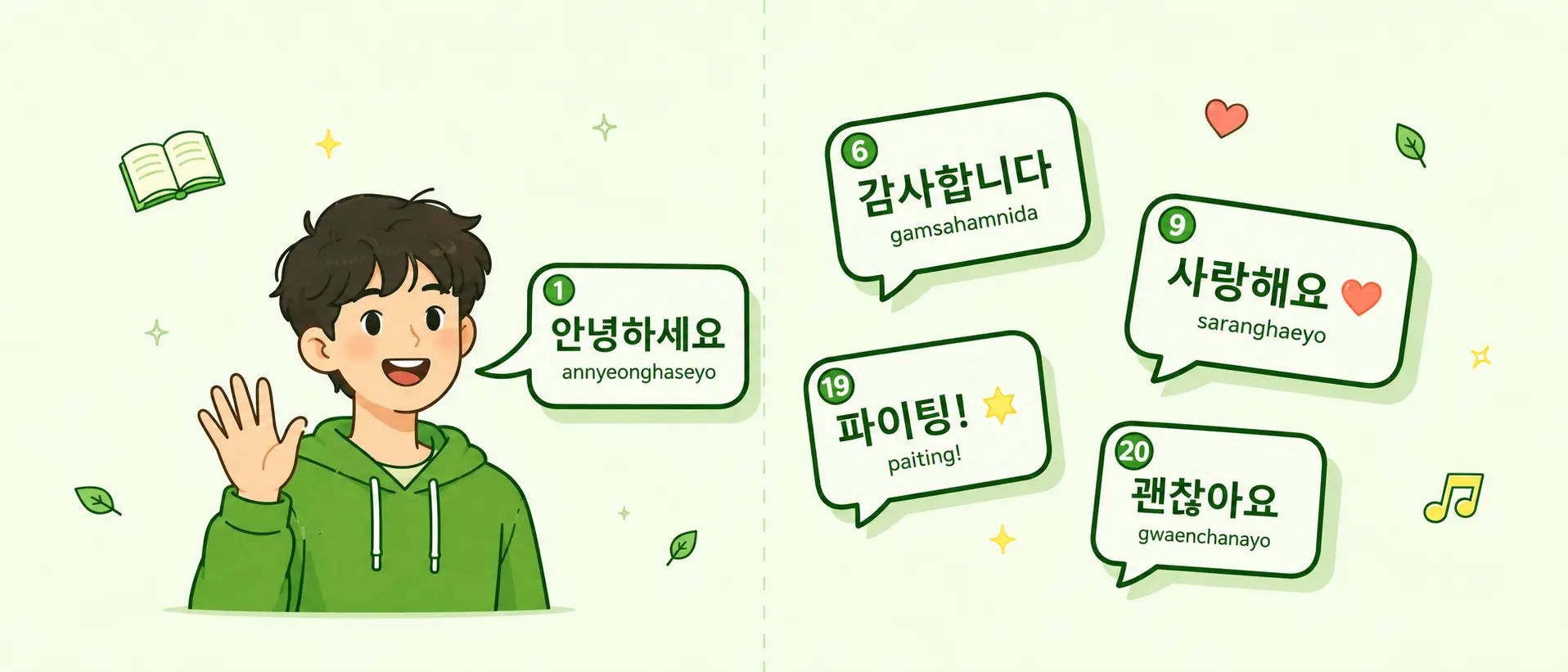
One of the biggest mistakes beginner Korean learners make is spending weeks on grammar before ever saying a word out loud. The problem? Speaking is how you learn to speak — not reading about it. These 20 essential Korean phrases will give you something real to use from your very first week, long before your grammar feels solid.
Each phrase below includes the Korean script, romanisation (to help with pronunciation only — work toward reading Hangul directly), the English meaning, and a usage note so you know exactly when and how to use it.
Hear These Phrases in Action
Romanisation only gets you so far — Korean pronunciation really clicks once you hear it spoken naturally. For a taste, here's a native speaker breaking down one of the most common everyday Korean greetings: 밥 먹었어? (literally "Did you eat?"). This short episode unpacks what that single phrase really means and how Koreans use it — a perfect warm-up before the 20 phrases below:
▶ Ep 5: what the everyday greeting "밥 먹었어?" really means
Fresh beginner lessons like this drop every week. Subscribe to SoodaKorean on YouTube 🔔 and you'll train your ear with real Korean between lessons — the single easiest habit for getting these phrases to stick.
Greetings
The first thing anyone learns — and also the most used in real life. These phrases open every conversation.
-
1안녕하세요 Annyeonghaseyo Hello / Good day The standard polite greeting. Use it with anyone — strangers, shopkeepers, teachers, colleagues. Safe in virtually every situation.
-
2안녕히 계세요 / 안녕히 가세요 Annyeonghi gyeseyo / Annyeonghi gaseyo Goodbye (said to someone staying / said to someone leaving) Korean has two goodbyes. If you're leaving, say 안녕히 계세요 to the person staying. If they're leaving, say 안녕히 가세요.
-
3처음 뵙겠습니다 Cheoeum boepgesseumnida Nice to meet you (formal first meeting) Used the very first time you meet someone. Formal — great for introductions in any context.
-
4반갑습니다 Bangapseumnida Nice / Pleased to meet you Slightly warmer than 처음 뵙겠습니다. Often said right after it — "Nice to meet you, pleased to meet you."
-
5잘 지냈어요? Jal jinaesseoyo? Have you been well? / How have you been? Used with someone you already know. The polite version of "How's it going?"
Polite Expressions
Koreans place high value on politeness. These phrases will make you immediately likeable.
-
6감사합니다 Gamsahamnida Thank you (formal) The most important phrase you'll ever learn. Use it constantly — in shops, restaurants, after receiving help. Never out of place.
-
7고마워요 Gomawoyo Thank you (informal polite) The casual but still polite version. Fine for everyday use with peers and friends.
-
8죄송합니다 Joesonghamnida I'm very sorry (formal apology) A sincere, formal apology. Use when you've made a mistake or need to express genuine remorse.
-
9괜찮아요 Gwaenchanayo It's okay / I'm fine / No worries One of the most versatile phrases in Korean. Used to accept an apology, say you're okay, decline something politely, or reassure someone.
-
10잘 부탁드립니다 Jal butakdeurimnida I look forward to working with you / Please take care of me Hard to translate directly, but essential in Korean professional and social contexts. Said when starting a new relationship, class, job, or project.
Essential Questions
These four questions will get you through most situations where you don't know what's happening.
-
11이게 뭐예요? Ige mwoyeyo? What is this? Point at something and ask. Essential for navigating menus, shops, and everyday life.
-
12어디예요? Eodiyeyo? Where is it? Add a location before it: "화장실 어디예요?" = "Where is the bathroom?" Endlessly useful for navigating.
-
13얼마예요? Eolmayeyo? How much is it? The phrase every traveller in Korea needs. Works in any shop, market, or restaurant where the price isn't displayed.
-
14한국어를 할 줄 아세요? Hangugeo-reul hal jul aseyo? Do you speak Korean? Useful for finding out if you can continue a conversation in Korean — or need to switch languages.
Survival Phrases
When things go sideways — and they will — these phrases keep you afloat.
-
15모르겠어요 Moreugesseoyo I don't know / I'm not sure Honest and humble. Much better than guessing. Koreans appreciate directness about what you don't know.
-
16잠깐만요 Jamkkanmanyo Just a moment, please Buy yourself time when you need to think, look something up, or wait. Used constantly in everyday conversation.
-
17천천히 말해 주세요 Cheoncheonhi malhae juseyo Please speak slowly A lifesaver. Native speakers talk fast — don't be shy about using this phrase. They will always slow down for you.
-
18이거 주세요 Igeo juseyo Please give me this / I'll have this Point at anything and say this. Ordering food, buying something, selecting from a menu — it works everywhere.
K-Drama Favourites
These phrases will feel immediately familiar if you've watched Korean dramas — and now you'll know exactly what they mean.
-
19사랑해요 Saranghaeyo I love you Polite form. The casual version (사랑해) is used between close partners and family. The formal version (사랑합니다) is deeply sincere — you'll hear it in dramatic moments. For every form and when to use each, see our full guide on how to say I love you in Korean.
-
20파이팅! / 화이팅! Paiting! / Hwaiting! Go for it! / You've got this! / Good luck! Korean's beloved cheer borrowed from English "fighting." Used before exams, sports, challenges — any time someone needs encouragement. Both spellings are correct.
Want to hear these from a native speaker — and actually practise saying them out loud?
Book a Free Trial Lesson 🗓️How to Actually Make These Stick
Reading a phrase list once won't make anything stick. Here's what actually works:
- Say each phrase out loud — even if you're alone. Mouthing words silently does almost nothing for retention.
- Write them in Hangul — even slowly. Writing connects visual, motor, and auditory memory simultaneously.
- Use them in context this week — order food in Korean, ask prices, greet someone, say goodbye. If prices or time trip you up, review Korean numbers next.
- Review with spaced repetition — add them to Anki and let the algorithm handle the review schedule.
- Use them with a teacher — speaking these with feedback on pronunciation will lock them in faster than self-study alone. For more ways to drill them, see how to practise speaking Korean, or follow the full path in our guide to learning Korean online.
"Language is not learned from lists — it's learned from use. These 20 phrases are your permission to start using Korean today."
Frequently Asked Questions
How many Korean phrases should a beginner learn first?
Start with around 20 high-frequency phrases — greetings, polite expressions, and a handful of survival questions like "how much is it?" and "where is the bathroom?". That's enough to handle a real interaction from day one without overwhelming your memory. Master these before moving on to grammar.
Should I learn Korean phrases in Hangul or romanization?
Learn them in Hangul. Romanization is a useful crutch for the first few days, but it teaches wrong pronunciation and slows you down long-term. Hangul takes only about a week to learn — see how to learn Hangul in one week — and reading phrases in the real script locks in correct sounds from the start.
What's the most useful Korean phrase to learn first?
안녕하세요 (annyeonghaseyo) — "hello." It's polite, works in almost any situation, and is the single phrase you'll use most. Close behind are 감사합니다 (thank you) and 얼마예요? (how much is it?). With just these three you can already greet, thank, and shop in Korean. For the full family of hellos and goodbyes — including the two goodbyes that trip everyone up — see our complete guide to Korean greetings. And if you're heading to Korea soon, our Korean travel phrases guide organises everything by situation, from taxis to emergencies.
Do you know your phrases?
5 questions · based on this article
Want to practise these phrases with a real Korean teacher?
Book a Free Trial Lesson 🗓️