
It's one of the first questions every Korean learner asks. And the most common answer — "2,200 hours according to the FSI" — is technically true but almost completely unhelpful. Because how long it takes to learn Korean depends entirely on what you mean by "learn Korean," how consistently you study, and how you study. If you want a concrete routine to start with, follow our 30-day Korean study plan for beginners.
This article gives you the honest version: realistic timelines for each level, what actually speeds you up, and what the numbers really mean for someone learning online today.
What the Research Actually Says
The Foreign Service Institute (FSI) — the US government's language training body — classifies languages by difficulty for native English speakers. Korean is in Category IV, alongside Japanese, Chinese, and Arabic. Their estimate: approximately 2,200 class hours to reach professional working proficiency (roughly C1 level).
That sounds daunting. But here's the important context: FSI training is intensive — six hours of classroom instruction per day, five days a week, for about 88 weeks. Most language learners are not doing that. And "professional working proficiency" is far beyond what most people actually need.
Is Korean Actually Hard to Learn?
Category IV makes Korean sound brutal — but the difficulty is unevenly distributed. Some parts of Korean are genuinely easier than Spanish or French, and knowing which is which changes how you study.
The easy parts: Hangul is one of the simplest writing systems on Earth — readable in a week. Korean has no tones (unlike Mandarin), no grammatical gender, no verb conjugation by person (the same verb form works for I/you/he/they), and pronunciation is far more regular than English. Once you learn a rule, it almost always holds.
The hard parts: The grammar is "backwards" for English speakers — verbs come last, and your brain needs time to rewire ("I store-to went" instead of "I went to the store"). Honorifics mean the same sentence changes shape depending on who you're talking to. And there's near-zero shared vocabulary with English, so every word is new — this is the real reason for the Category IV label, not complexity.
In practice: Korean isn't harder to learn than European languages so much as slower at the start. The first three months feel steep because nothing is familiar. Then the consistency kicks in — the logical structure means fewer exceptions to memorise — and most learners find intermediate Korean more predictable than intermediate French.
What "Learning Korean" Actually Means
Before you can answer "how long," you need to define your target. These are four very different goals:
- Survival Korean — ordering food, asking directions, basic shopping in Korea
- Conversational Korean — holding everyday conversations with Korean speakers on common topics
- Intermediate fluency — understanding K-dramas with Korean subtitles, passing TOPIK Level 3
- Advanced / near-native — working in Korean, understanding any media, passing TOPIK Level 5–6
Each goal requires dramatically different investment. Most learners are aiming for conversational or intermediate — and those are achievable much faster than 2,200 hours suggests.
Realistic Timelines by Level
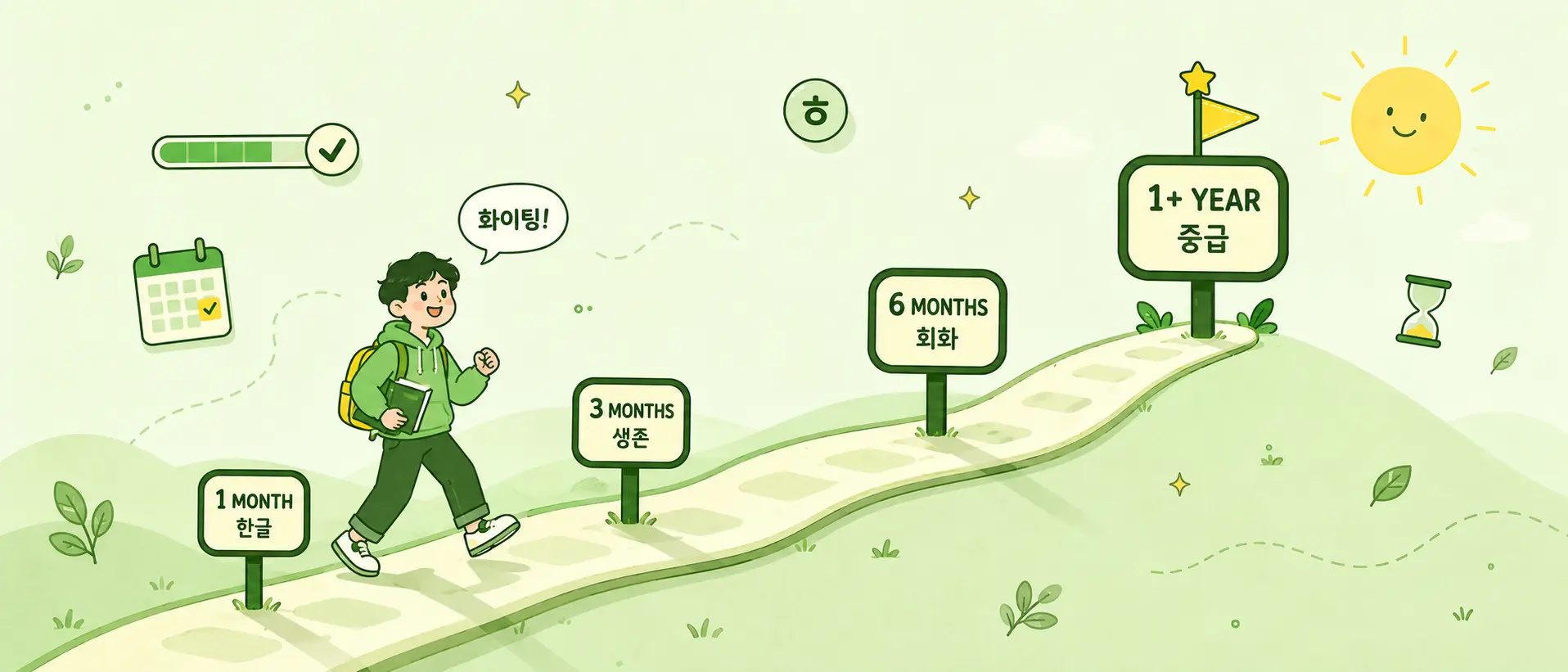
These estimates assume consistent daily study of 30–60 minutes plus weekly lessons with a teacher. Results vary — but this is what most motivated learners actually experience:
weeks
You can read Korean script without hesitation. You know 100–200 words and basic greetings. This milestone changes everything — Korean content suddenly becomes accessible.
months
You can order food, ask simple questions, handle basic situations in Korea. Sentences are short and slow, but you can make yourself understood.
months
You can talk about yourself, your life, your interests. You handle everyday situations with growing confidence. TOPIK Level 1 is within reach. This is where dedicated learners with a good teacher often arrive.
years
K-dramas with Korean subtitles are followable. You can discuss most everyday topics. TOPIK Level 2–3 is achievable. You make mistakes, but communication rarely breaks down.
years
You operate comfortably in most situations. You can read Korean news, watch undubbed media, discuss complex topics. TOPIK Level 4–5 territory.
How Study Intensity Changes Everything
The timelines above assume moderate, consistent study. Here's what happens when you change the intensity:
Casual learner
~15 min/dayProgress is slow but real. Basic conversation in 12–18 months. Good for maintaining motivation long-term without burnout.
Consistent learner
~45 min/dayThe sweet spot for most people. Basic conversation in 4–6 months. Intermediate in 12–18 months. Manageable alongside work or study.
Intensive learner
2+ hours/dayFast results. Conversational in 2–3 months. Intermediate in 6–8 months. Requires significant time commitment — works well for gap years or dedicated periods.
Immersive learner
Living in KoreaFastest possible route. Full immersion can compress a year of home study into 3–4 months, especially with daily real-world speaking practice.
What Actually Speeds Up Your Progress
Not all study time is equal. An hour of passive exposure to Korean music is not the same as an hour of active speaking practice. Here's what genuinely accelerates results:
- Weekly lessons with a native teacher — speaking with corrections is the single highest-value activity per hour spent (here's why a tutor beats apps for this)
- Daily consistency over marathon sessions — 20 minutes every day beats 3 hours on Saturday every time
- Spaced repetition for vocabulary — using an SRS app like Anki means you never over-review words you know and never forget words you're learning
- Active listening, not passive — watching Korean content with the intention of understanding, not just background noise
- Speaking from week one — learners who wait until they feel "ready" to speak plateau at beginner level
Item #1 on that list — done. Your free trial lesson is one click away.
Book a Free Trial Lesson 🗓️"The learner who speaks imperfectly every day will outpace the learner who waits for perfection every time."
Frequently Asked Questions
How many hours does the FSI say it takes to learn Korean?
The Foreign Service Institute (FSI) — the US State Department's official language-difficulty ranking — estimates 2,200 class hours to reach professional working proficiency in Korean, a Category IV language (the hardest tier for English speakers, alongside Japanese, Chinese, and Arabic). That figure assumes full-time immersive training: six hours a day, five days a week, for about 88 weeks. Everyday conversational Korean — what most learners actually want — takes a fraction of that time; see the realistic timelines above.
Is Korean hard to learn for English speakers?
It's classified as difficult — Category IV by the FSI. The grammar structure (SOV word order, particles, speech levels) is genuinely unfamiliar for English speakers. But Korean also has real advantages: an alphabet you can learn in days, consistent pronunciation rules, and grammar that is surprisingly regular with very few exceptions. Most learners find it more manageable than the reputation suggests, especially once they have structured guidance.
Can I become conversational in 6 months?
Yes — with consistent daily study (30–60 minutes) combined with weekly lessons with a native teacher. After 6 months most committed learners can hold basic everyday conversations, handle common situations, and follow slow Korean speech. "Conversational" at 6 months means functional, not perfect — you'll still make mistakes, but you'll communicate.
What is TOPIK and how long does it take to pass?
TOPIK (Test of Proficiency in Korean) is the official Korean language proficiency exam. It has 6 levels across two tests: TOPIK I (Levels 1–2) and TOPIK II (Levels 3–6). TOPIK I is achievable in 3–6 months of consistent study. TOPIK II Level 3–4 typically requires 1–2 years. Level 5–6 — the level required for academic admission at Korean universities — is a multi-year commitment.
Test what you've learned
5 questions · based on this article
Want to reach your Korean goal faster — with a real teacher by your side?
Book a Free Trial Lesson 🗓️