
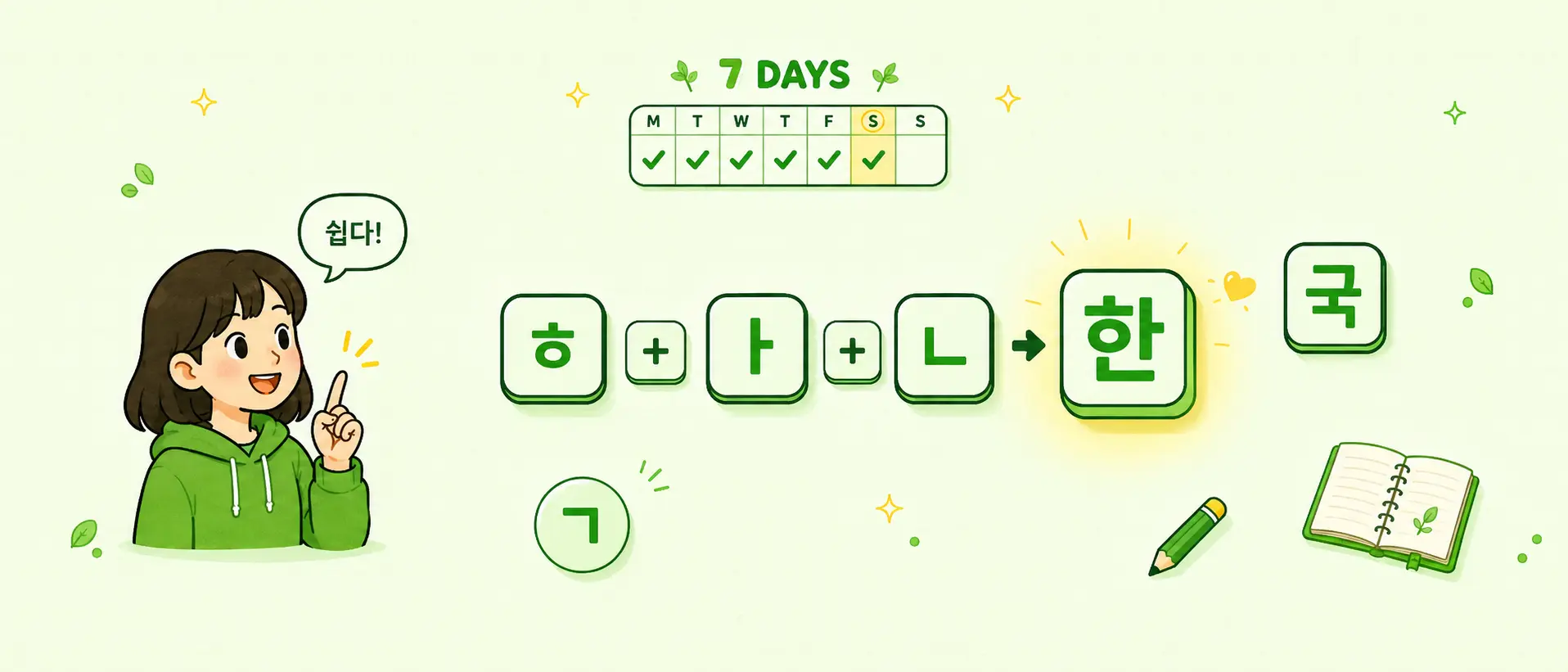
Most people hear "Korean alphabet" and picture rows of mysterious symbols they'll never crack. But here's the thing — Hangul is not like Chinese characters. It's a phonetic alphabet with just 24 base letters, designed in the 15th century specifically to be easy to learn. King Sejong, who commissioned it, reportedly wanted ordinary people to be able to pick it up in a few days.
He wasn't wrong. With the right order and a little daily practice, you can go from zero to reading Korean syllables in one week. Here's exactly how.
Why Learn Hangul Before Anything Else
A lot of beginner resources use romanisation — writing Korean sounds in the Latin alphabet (e.g. "annyeonghaseyo"). It feels easier at first, but it's actually slowing you down.
Romanisation is inconsistent. The same Korean sound can be romanised multiple ways depending on the source. It also trains your brain to read sounds through the filter of English, which creates pronunciation problems that are very hard to fix later.
Learning Hangul first takes 1–2 weeks but pays off immediately. After that, every piece of Korean content becomes accessible — menus, signs, song lyrics, subtitles. Your brain starts connecting the visual shapes to sounds directly, which is exactly how native speakers process it.
How Hangul Actually Works
Hangul has two types of letters: consonants (자음, jaeum) and vowels (모음, moeum). These aren't written one after another like the English alphabet — they're assembled into syllable blocks.
Each block represents one syllable and always follows the same structure: at minimum, one consonant + one vowel. A final consonant (called a 받침, batchim) can be added underneath.
For example, the word 한국 (Korea) is two syllable blocks: 한 (han) and 국 (guk). Each block has a top consonant, a vowel, and a bottom consonant.
Once you understand this structure, reading becomes a matter of recognising shapes — not memorising thousands of characters.
The 14 Basic Consonants
Start here. These are the foundation. Many of them have a visual logic — the shape hints at where in your mouth the sound is made.
| Letter | Romanisation | Sound hint |
|---|---|---|
| ㄱ | g / k | Like "g" in "go" (or "k" at end of syllable) |
| ㄴ | n | Like "n" in "nice" |
| ㄷ | d / t | Like "d" in "dog" |
| ㄹ | r / l | Between English "r" and "l" — a flap sound |
| ㅁ | m | Like "m" in "map" |
| ㅂ | b / p | Like "b" in "boat" |
| ㅅ | s | Like "s" in "sun" |
| ㅇ | silent / ng | Silent at syllable start; "ng" at the end |
| ㅈ | j | Like "j" in "jug" |
| ㅊ | ch | Like "ch" in "church" |
| ㅋ | k | Aspirated "k" — a puff of air |
| ㅌ | t | Aspirated "t" |
| ㅍ | p | Aspirated "p" |
| ㅎ | h | Like "h" in "hat" |
The 10 Basic Vowels
Korean vowels are built from three elements: a vertical line, a horizontal line, and short tick marks. Once you see the pattern, you can guess a new vowel's sound just from its shape.
The most important ones to start with are the pure vowels:
- ㅏ — "a" (like in "father")
- ㅓ — "eo" (like in "uh")
- ㅗ — "o" (like in "go")
- ㅜ — "u" (like in "moon")
- ㅡ — "eu" (no English equivalent — like "uh" with rounded lips)
- ㅣ — "i" (like in "see")
The remaining four add a "y" sound in front: ㅑ (ya), ㅕ (yeo), ㅛ (yo), ㅠ (yu). Notice they have an extra tick compared to their base vowel.
The Complete Korean Alphabet Chart: All 40 Letters
The 14 consonants and 10 vowels above are the core — but the full Korean alphabet has 40 letters. The remaining 16 are built from the ones you already know: 5 "double" consonants and 11 compound vowels. You don't need to memorise these in week one, but keep this chart handy as a reference.
The 5 Double (Tense) Consonants
These are written as a doubled basic consonant and pronounced with a tighter, tenser sound — no puff of air.
| Letter | Romanisation | Sound hint |
|---|---|---|
| ㄲ | kk | Tense "g" — like "g" in "gone" said firmly |
| ㄸ | tt | Tense "d" — like "d" in "duh" said firmly |
| ㅃ | pp | Tense "b" — like "b" in "bad" said firmly |
| ㅆ | ss | Tense "s" — a sharp hiss, like "ss" in "essay" |
| ㅉ | jj | Tense "j" — like "j" in "gotcha" |
The 11 Compound Vowels
Compound vowels combine two basic vowel shapes. A few of them sound nearly identical in modern Korean (ㅐ/ㅔ and ㅒ/ㅖ) — even native speakers rely on context to tell them apart, so don't stress about hearing the difference.
| Letter | Romanisation | Sound hint |
|---|---|---|
| ㅐ | ae | Like "e" in "bed" |
| ㅔ | e | Like "e" in "bed" (same as ㅐ today) |
| ㅒ | yae | "y" + "e" in "bed" |
| ㅖ | ye | Like "ye" in "yes" |
| ㅘ | wa | Like "wa" in "wand" |
| ㅙ | wae | Like "we" in "wet" |
| ㅚ | oe | Like "we" in "wet" (same as ㅙ today) |
| ㅝ | wo | Like "wo" in "wonder" |
| ㅞ | we | Like "we" in "wet" |
| ㅟ | wi | Like "wee" in "week" |
| ㅢ | ui | "eu" + "i" said quickly together |
Your 7-Day Study Plan
You don't need hours per day. Fifteen focused minutes beats ninety scattered ones. Here's a simple structure that works:
- Days 1–2: Learn consonants ㄱ ㄴ ㄷ ㄹ ㅁ ㅂ ㅅ. Write each one 10 times.
- Day 3: Learn consonants ㅇ ㅈ ㅊ ㅋ ㅌ ㅍ ㅎ. Review all 14.
- Day 4: Learn the 6 pure vowels. Combine them with consonants you know: 가 나 다 라…
- Day 5: Learn the 4 y-vowels. Read simple syllable blocks aloud.
- Day 6: Practice reading real words — 한국, 사람, 감사합니다. Don't worry about meaning yet.
- Day 7: Review everything. Try reading a simple Korean sentence cold.
"The goal of week one isn't to understand Korean — it's to make the shapes feel familiar. Meaning comes after fluency of perception."
Got Hangul nailed? Your next step is vocabulary and speaking — let's do it together.
Book a Free Trial Lesson 🗓️What Comes After Hangul
Once you can read Hangul smoothly — even slowly — you're ready to start building vocabulary and grammar at the same time — our 30-day Korean study plan picks up exactly where this guide leaves off. If you're studying remotely, our complete guide to learning Korean online maps out the whole path from here. This is where a good teacher makes a real difference. A structured approach that introduces grammar in context (not as isolated rules) will accelerate your progress significantly.
Many of my students can hold simple conversations within 2–3 months of consistent weekly lessons. The Hangul foundation you build this week is the first step toward that.
Test what you've learned
5 questions · based on this article
Want to practise Hangul — and everything that comes next — with a real teacher?
Book a Free Trial Lesson 🗓️