
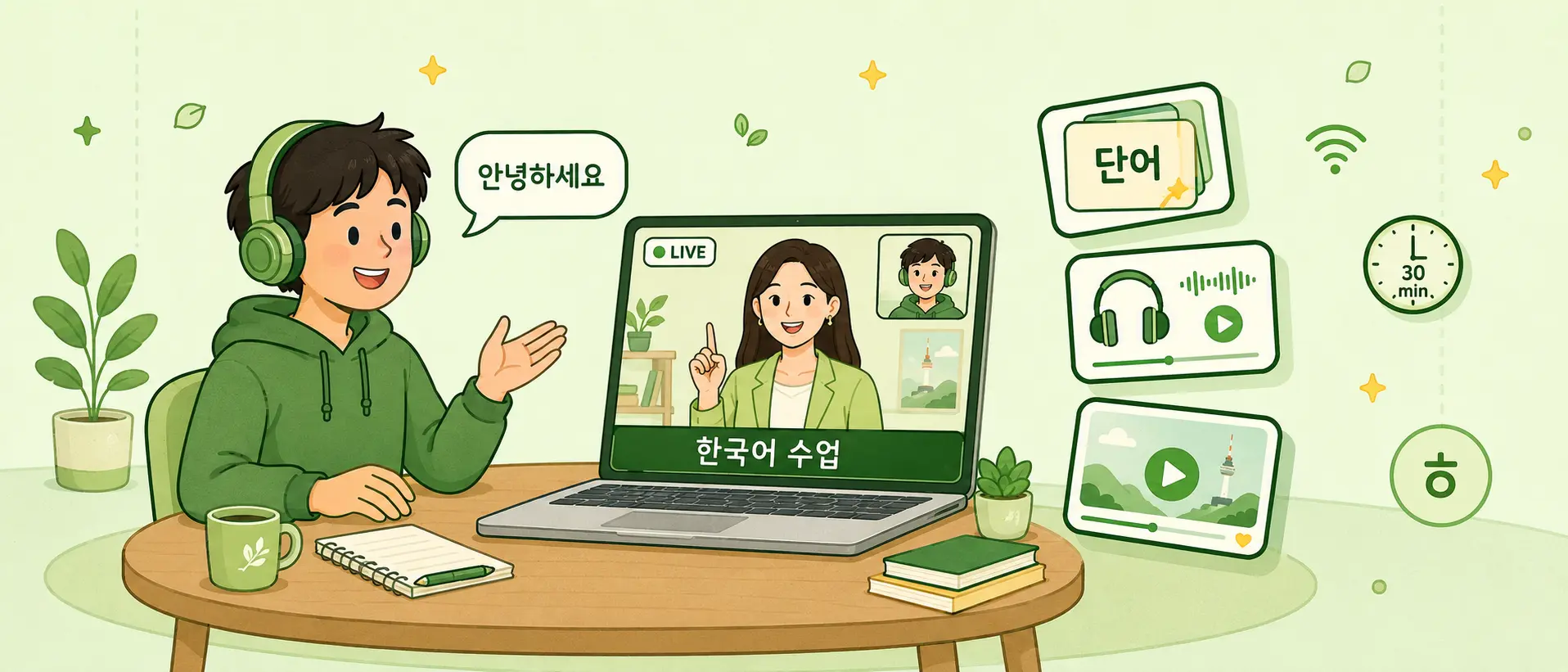
Maybe it started with a K-drama you couldn't stop watching. A BTS song stuck in your head for weeks. Or a trip to Seoul you've already started planning. Whatever brought you here — you're asking the right question. And the answer is: yes, you can absolutely learn Korean online, and you can do it effectively, affordably, and at your own pace.
This guide gives you the exact roadmap. Not a list of apps to download — a real, structured approach that takes you from zero to conversational Korean, step by step. If you want that roadmap as a calendar, use our 30-day Korean study plan alongside this guide.
Why Learn Korean Online?
Online Korean learning has advantages that traditional classroom study simply can't match:
- Flexibility — study at 6am or midnight, five minutes or two hours
- Access to native teachers — you can learn directly from a Korean speaker without living near one
- Immersion is built-in — Korean content (YouTube, Netflix, podcasts, music) is everywhere online, making real-world input effortless to access
- Affordability — quality online Korean instruction is a fraction of in-person language school costs
- Personalisation — a good online teacher tailors lessons to your goals: travel, K-dramas, business, TOPIK exam prep
The key is knowing how to structure your study so you don't waste months spinning in circles. Here's that structure.
Step 1 — Learn Hangul First (Don't Skip This)
Before vocabulary, before grammar, before anything else — learn Hangul, the Korean writing system. It has 24 base letters and follows a logical syllable-block structure. Most motivated beginners can read basic Hangul within 2–4 hours of focused study.
Many learners start with romanisation — writing Korean sounds using English letters (e.g. "annyeonghaseyo"). This feels easier at first but is actually a trap. Romanisation is inconsistent, trains wrong pronunciation habits, and slows everything down long-term.
We have a full guide dedicated to this: How to Learn Hangul in One Week. Start there if you're on day one.
Step 2 — Build Core Vocabulary
With Hangul down, the next priority is vocabulary. Aim for the most common 500–1,000 Korean words first. Research consistently shows that the 1,000 most frequent words in any language cover around 85% of everyday speech. In Korean, those words unlock most conversations you'll ever have as a beginner.
Focus on these categories first:
- Greetings and basic phrases (안녕하세요, 감사합니다, 괜찮아요)
- Numbers — both Sino-Korean (일, 이, 삼…) and Native Korean (하나, 둘, 셋…)
- Time, days, and dates
- Common verbs: to go, to eat, to want, to know, to do, to like
- Question words: who, what, where, when, why, how
Use spaced repetition (SRS) for vocabulary review. Apps like Anki let you schedule flashcard reviews at the exact moment you're about to forget a word, making retention dramatically more efficient than random review. Even 10 minutes of SRS review per day compounds significantly over months.
Step 3 — Understand Grammar in Context
Korean grammar is genuinely different from English — and you need to understand the core differences early. But here's the important thing: learn grammar through sentences, not rules. Memorising grammar tables in isolation doesn't build the habit of actually using them.
Sentence order is different
Korean follows Subject–Object–Verb order. Where English says "I drink coffee," Korean says something closer to "I coffee drink." This feels unnatural at first but becomes automatic with enough exposure. For a deeper walkthrough, read our guide to Korean sentence structure.
Particles mark grammatical roles
In English, word order tells you who is doing what. In Korean, small particles attached to nouns do that job. 이/가 marks the subject, 을/를 marks the object, 은/는 marks the topic. This lets Korean sentences be rearranged more freely than English ones; start with our simple guide to 은/는 vs 이/가.
Speech levels matter from day one
Korean has formal and informal speech, and using the wrong register can be awkward. Start with 해요체 (polite informal) — it's used in most everyday situations, K-dramas between acquaintances, and casual service interactions. Once you have this level solid, adding the other registers is much easier.
The best way to absorb grammar in context is simply to listen to it. This episode of our Korean podcast tells a short, slow everyday story built around basic verbs — exactly the kind of repeated, in-context exposure that makes grammar stick without memorising tables. Put it on, follow along, and let the patterns sink in:
▶ Ep 43: a slow, beginner-friendly daily story using basic Korean verbs
A new listening episode lands every week — perfect passive practice for your commute or coffee break. Subscribe to SoodaKorean on YouTube 🔔 so there's always fresh Korean in your ears.
Step 4 — Speak From Week One
This is where most self-studiers go wrong. They wait until they feel "ready" to speak — and that moment never comes, because speaking is itself how you get ready.
Even in your first week, say your Hangul practice aloud. In week two, use your vocabulary in simple sentences, even just to yourself. By week three, try having a basic exchange with a teacher or language partner.
Online lessons with a native Korean teacher are the single most efficient tool for this. A good teacher does three things no app can: they model natural pronunciation, they correct errors in real time before bad habits form, and they push you to produce language — not just consume it.
Even one lesson per week, combined with daily self-study, produces dramatically faster progress than self-study alone. (Weighing your options? See Korean tutor vs. apps and our guide to practising speaking Korean.)
One lesson a week is all it takes to make your study time count. Try the first one free.
Book a Free Trial Lesson 🗓️Your Weekly Study Routine
You don't need hours per day. A consistent 40–60 minutes beats scattered two-hour weekend sessions every time. Here's a practical template:
| Time | Activity | Goal |
|---|---|---|
| 10 min daily | SRS flashcard review (Anki) | Vocabulary retention |
| 20 min daily | New vocabulary + grammar study | Building knowledge base |
| 15 min daily | Active listening (Korean podcast / YouTube) | Ear training + input |
| 1× per week | Live lesson with a Korean teacher | Speaking + corrections |
| Weekend | Korean content for fun (drama, music, film) | Immersion + motivation |
Realistic Milestones
Honest timelines help you stay motivated rather than discouraged. Here's what consistent study (the routine above) typically produces:
-
1MAfter 1 month Hangul fluent, 200+ words, can use basic greetings and introduce yourself
-
3MAfter 3 months Basic conversations — ordering food, asking directions, simple questions and answers
-
6MAfter 6 months Comfortable in everyday situations, can follow slow Korean speech, 1,000+ words
-
1YAfter 1 year Upper intermediate — K-dramas with Korean subtitles, TOPIK Level 2–3 within reach
"Consistency is the only variable that matters. 20 minutes every day for a year beats 4 hours every Saturday every time."
Can You Learn Korean Online for Free?
Honestly: yes, further than most languages. Korean has an unusually rich free ecosystem — and you should use it. A realistic free toolkit looks like this:
- YouTube lessons — free structured teaching for every level, from Hangul to grammar deep-dives (we publish weekly lessons on our channel)
- Flashcard apps with spaced repetition — free and the single best tool for vocabulary
- Korean media — K-dramas, K-pop, and podcasts are free listening practice disguised as entertainment
- Language exchange apps — free conversation partners, in exchange for helping them with English
So where's the catch? Free resources are excellent at input — reading, listening, vocabulary — and weak at output. Nobody corrects your pronunciation, nobody untangles your grammar mistakes, and language-exchange partners are (understandably) too polite to fix every error. That's why most self-taught learners read far better than they speak. The free-first path works well: start free, build your foundation, and add a teacher when speaking becomes your bottleneck — usually around month two or three. We've broken down exactly what apps can and can't do in our tutor vs. apps comparison.
Frequently Asked Questions
Can I learn Korean online without a teacher?
Yes — apps, YouTube, and textbooks can take you a long way. But a teacher dramatically shortens the path. They correct pronunciation errors before they become habits, explain grammar in context, and give you real speaking practice from day one. Most learners who rely only on apps plateau at beginner level.
Is Korean hard to learn for English speakers?
Korean is classified as a Category IV language by the FSI — meaning it takes significantly more time than European languages for native English speakers. But "hard" is relative. The grammar is remarkably consistent with very few exceptions, the alphabet is learnable in days, and pronunciation is more regular than English. For realistic timelines, see our full breakdown of how long it takes to learn Korean.
What is the best way to learn Korean online?
The most effective approach combines: (1) structured lessons with a native teacher, (2) daily vocabulary review using spaced repetition, (3) active listening through Korean content, and (4) speaking practice from week one. Doing just one of these is never as effective as combining them.
Test what you've learned
5 questions · based on this article
Ready to put this guide into action with a real Korean teacher?
Book a Free Trial Lesson 🗓️