
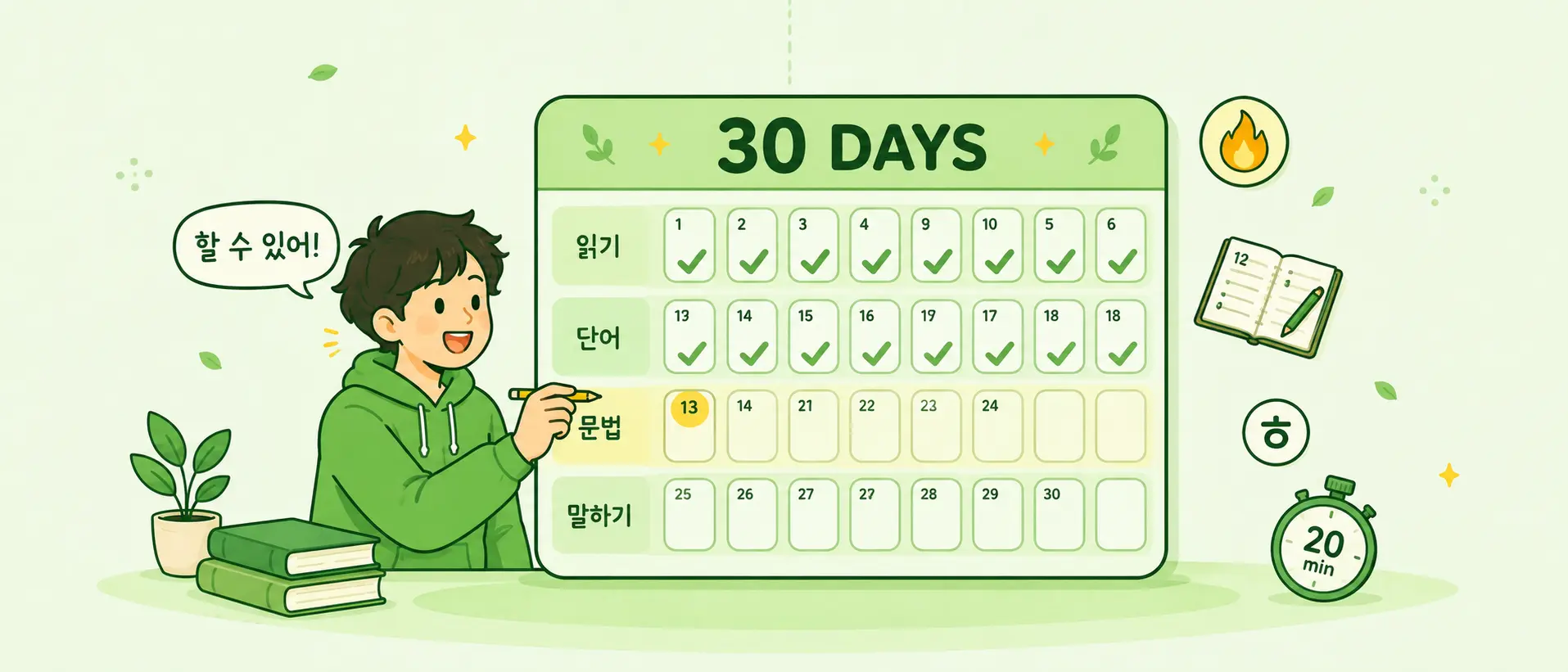
"I want to learn Korean" is easy to say. The hard part is knowing what to actually do tomorrow morning. Most beginners drown in advice, download five apps, and quit in three weeks with nothing to show for it.
This plan fixes that. It's a realistic, 30-day Korean study plan that takes a total beginner from "I can't read anything" to reading Hangul, knowing a few hundred words, understanding basic grammar, and holding simple exchanges. You'll need just 20–40 minutes a day — and if you're curious how those daily minutes add up over months, try our Korean study time calculator. Let's go.
How This Plan Works
Every study day is split into three short blocks. This structure repeats all month — only the content changes:
| Block | Time | What you do |
|---|---|---|
| Review | 5–10 min | Flashcards (SRS) of everything learned so far |
| New material | 10–20 min | The day's new letters, words, or grammar |
| Out loud | 5–10 min | Say today's material aloud — read, shadow, or self-talk |
Take one rest day per week (the schedule below builds it in). Rest days keep you consistent for the long haul — burnout is the real enemy, not slow days.
Week 1 — Learn to Read (Hangul)
Do not skip this and do not use romanisation. Reading Hangul is the single highest-leverage thing a beginner can do, and it's faster than you think. Follow our dedicated guide — How to Learn Hangul in One Week — alongside this schedule.
- Day 1–2: Basic vowels (ㅏ ㅑ ㅓ ㅕ ㅗ ㅛ ㅜ ㅠ ㅡ ㅣ) — write and say each
- Day 3–4: Basic consonants (ㄱ ㄴ ㄷ ㄹ ㅁ ㅂ ㅅ ㅇ…) and how syllable blocks form
- Day 5: Double consonants (ㄲ ㄸ ㅃ…) and complex vowels (ㅐ ㅔ ㅚ…)
- Day 6: 받침 — final consonants and basic reading rules
- Day 7: Rest + read real Korean: signs, K-pop titles, menus
End of week 1: you can sound out almost any Korean word, even if you don't know its meaning yet.
Week 2 — Core Words & First Phrases
Now that you can read, start stocking your brain with the highest-frequency words and survival phrases. Pair this week with our 20 essential Korean phrases.
- Day 8–9: Greetings & courtesy — 안녕하세요, 감사합니다, 죄송합니다
- Day 10–11: Numbers (Sino & Native Korean), days, basic time
- Day 12: Everyday nouns — food, places, people, objects (aim 10–15/day)
- Day 13: Common verbs — to go, eat, want, do, like, have
- Day 14: Rest + review all week-2 vocabulary aloud
End of week 2: ~120–150 words and a handful of ready-to-use phrases.
Week 3 — Build Real Sentences (Grammar)
Time to connect words into sentences. Learn grammar through examples, not tables — for every pattern, say five real sentences out loud.
- Day 15–16: Korean word order (Subject–Object–Verb) and the polite -요 ending
- Day 17: Topic/subject particles 은/는, 이/가
- Day 18: Object particle 을/를 and "to be" (이에요/예요)
- Day 19: Present tense + simple questions (who, what, where)
- Day 20: Past tense basics (-았/었어요)
- Day 21: Rest + build 10 sentences about your own day
End of week 3: you can make simple, correct sentences about yourself and ask basic questions.
Week 4 — Put It Together & Speak
The final week is about using everything. Less new input, much more output. This is where many learners feel real momentum — and where a teacher accelerates you the most. (If you want help here, see our guide to practising speaking Korean.)
- Day 22–23: Self-introduction — name, country, job, hobbies, why you're learning Korean
- Day 24: Everyday scenarios — ordering food, shopping, asking directions
- Day 25: Shadowing — copy a short native dialogue line by line
- Day 26: Record a 1-minute spoken introduction; listen back and redo it
- Day 27: A real conversation — a Korean tutor (vs. apps), language partner, or AI exchange
- Day 28: Review your weakest area from the whole month
- Day 29: Re-record your introduction and compare to Day 26 🎉
- Day 30: Celebrate — and plan your next 30 days
Day 27 is a real conversation. Make it count — book a free trial lesson and speak with a real teacher.
Book a Free Trial Lesson 🗓️What You'll Have After 30 Days
-
읽기Reading Read and write all of Hangul, no romanisation needed
-
단어Vocabulary 200–300 of the most useful everyday words
-
문법Grammar Sentence structure, particles, present & past tense
-
말Speaking Introduce yourself and handle simple everyday exchanges
5 Rules to Actually Finish
- Same time daily — attach study to an existing habit (morning coffee, commute)
- Tiny over nothing — on bad days, do 5 minutes; never zero, to protect the streak
- Always out loud — silent study won't build speaking
- Track it — tick each day off; the visible chain is motivating
- One real conversation a week — nothing accelerates progress like it
"A beginner who studies 30 minutes every day for a month will overtake one who 'binges' Korean every other weekend — every single time."
After the 30 Days
Keep the daily habit and repeat the structure with harder material: more vocabulary, new grammar (future tense, connectors like -고 and -지만), and longer conversations. The biggest upgrade you can make is adding regular lessons so someone corrects you and pushes your speaking. For the full roadmap, read How to Learn Korean Online.
Looking for that harder material? This episode of our Korean podcast is built for exactly this stage — it runs through 20 beginner-to-intermediate grammar points and 20 useful vocabulary words in one sitting, so you can review what you've learned and stretch a little further. Treat it as a checkpoint after your 30 days:
▶ Ep 54: 20 grammar points + 20 vocab words for beginner–intermediate learners
We post a new lesson every week. Subscribe to SoodaKorean on YouTube 🔔 to keep that daily-habit momentum going long after day 30.
Frequently Asked Questions
Can you learn Korean in 30 days?
You won't be fluent in 30 days, but you can build a real foundation: read and write Hangul, know a few hundred words, understand basic grammar, and hold simple introductions and everyday exchanges. This plan gets a total beginner there with 20–40 minutes of focused study a day.
How much time per day does this plan need?
About 20–40 minutes. Consistency matters far more than duration — 30 minutes every day beats one three-hour weekend session. Each day splits into short blocks for review, new material, and speaking.
What should I do after the 30-day plan?
Keep the daily habit and add regular speaking practice — ideally weekly lessons with a tutor who can correct you and push your conversation skills. Keep expanding vocabulary with spaced repetition and start consuming Korean content like podcasts and dramas for immersion.
Test what you've learned
5 questions · based on this article
Start your 30 days with a real teacher in your corner. The first lesson is free.
Book a Free Trial Lesson 🗓️