
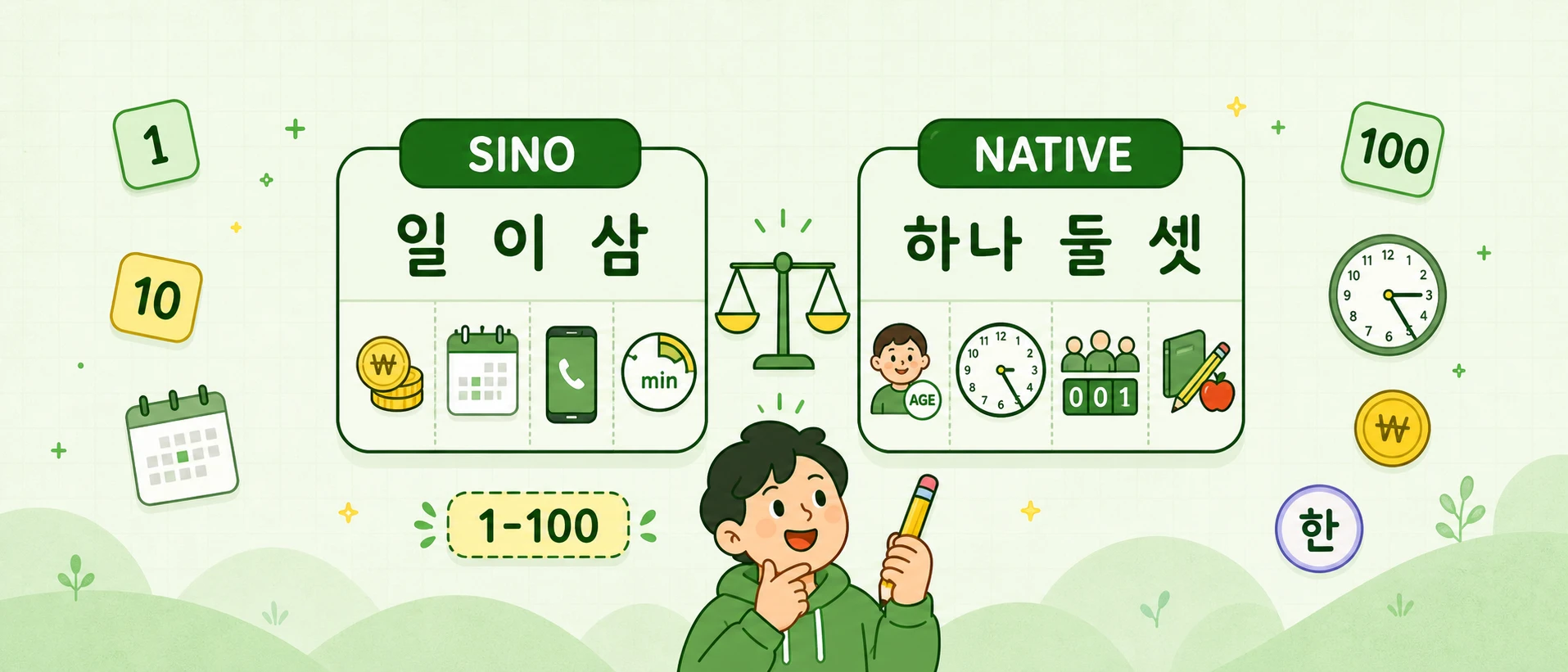
Here's the first surprise every Korean learner hits with numbers: there are two completely different counting systems, and you have to know both. The good news? Once you understand which system goes where, it's far more logical than it looks — and this guide gives you the full Korean numbers charts from 1 to 100 plus a cheat-sheet you can come back to anytime.
Why Korean Has Two Number Systems
Korean uses Sino-Korean numbers and Native Korean numbers:
- Sino-Korean — borrowed from Chinese characters (Hanja), historically used for records, math, money, and measurements. Used for dates, prices, phone numbers, minutes, and any number 100+.
- Native Korean — Korea's own original system, used for the everyday things you interact with: counting objects and people, your age, and the hour of the day. It only goes up to 99.
Think of it this way: Sino = the "formal record-keeping" system; Native = the "things in front of me" system. Keep that mental split and the rest falls into place.
Sino-Korean Numbers 1–100
Sino-Korean is the easier system to build, because larger numbers are just combinations (20 = "two-ten" = 이십). Learn 1–10 and the tens, and you can say everything in between.
| # | Hangul | Romanisation |
|---|---|---|
| 1 | 일 | il |
| 2 | 이 | i |
| 3 | 삼 | sam |
| 4 | 사 | sa |
| 5 | 오 | o |
| 6 | 육 | yuk |
| 7 | 칠 | chil |
| 8 | 팔 | pal |
| 9 | 구 | gu |
| 10 | 십 | sip |
| # | Hangul | Romanisation |
|---|---|---|
| 20 | 이십 | isip |
| 30 | 삼십 | samsip |
| 40 | 사십 | sasip |
| 50 | 오십 | osip |
| 60 | 육십 | yuksip |
| 70 | 칠십 | chilsip |
| 80 | 팔십 | palsip |
| 90 | 구십 | gusip |
| 100 | 백 | baek |
Native Korean Numbers 1–99
Native numbers have unique words for each ten (you can't just stack them like Sino), so this is the system that takes a little more memorising. It stops at 99.
| # | Hangul | Romanisation |
|---|---|---|
| 1 | 하나 | hana |
| 2 | 둘 | dul |
| 3 | 셋 | set |
| 4 | 넷 | net |
| 5 | 다섯 | daseot |
| 6 | 여섯 | yeoseot |
| 7 | 일곱 | ilgop |
| 8 | 여덟 | yeodeol |
| 9 | 아홉 | ahop |
| 10 | 열 | yeol |
| # | Hangul | Romanisation |
|---|---|---|
| 20 | 스물 | seumul |
| 30 | 서른 | seoreun |
| 40 | 마흔 | maheun |
| 50 | 쉰 | swin |
| 60 | 예순 | yesun |
| 70 | 일흔 | ilheun |
| 80 | 여든 | yeodeun |
| 90 | 아흔 | aheun |
Numbers click fastest when you say them out loud with feedback. Try a free trial lesson.
Book a Free Trial Lesson 🗓️When to Use Which: The Cheat-Sheet
This is the part learners actually search for. Bookmark this table:
| Use case | System | Example |
|---|---|---|
| Counting objects / people | Native | 사과 세 개 (3 apples) |
| Age | Native | 스물다섯 살 (25 yrs) |
| The hour (time) | Native | 세 시 (3 o'clock) |
| Minutes (time) | Sino | 삼십 분 (30 min) |
| Money / prices | Sino | 오천 원 (5,000 won) |
| Dates (year/month/day) | Sino | 유월 (June) |
| Phone numbers | Sino | 공일공… (010…) |
| Numbers 100+ | Sino | 백, 천, 만 |
Telling Time: The Mixed System
Time is the famous "gotcha" — it uses both systems in one breath. The hour is Native, the minutes are Sino:
3:25 → 세 시 이십오 분 (se si isibo bun)
"three (Native) o'clock, twenty-five (Sino) minutes"
Memorise one example like this and the rule sticks for good: 시 (hour) takes Native, 분 (minute) takes Sino.
A Quick Word on Counters
When you count things in Korean, you usually need a counter word after the number — similar to "two sheets of paper" in English. The most common ones pair with Native numbers:
- 개 — general objects (한 개 = one item)
- 명 — people (두 명 = two people)
- 마리 — animals (세 마리 = three animals)
- 살 — age (스무 살 = 20 years old)
You don't need to master every counter now — just know that the number and counter travel together, and counters are where those shortened forms (한, 두, 세…) show up.
Putting Numbers to Work
Numbers are some of the highest-value vocabulary you'll learn — you'll use them every single day. Pair them with a few essential phrases and you can already shop, order, and tell time. Curious how old you'd be in Korea? Try our free Korean age calculator — it even shows your age spoken in Native Korean. Next, grab the 20 essential Korean phrases, make sure your Hangul reading is solid, and see the full beginner path in how to learn Korean online.
Charts get you started, but numbers only stick once you hear them in real speech. This podcast episode walks through Korean numbers and how to say your age at a relaxed, beginner-friendly pace — listen along and the two systems start to feel natural instead of memorised:
▶ Ep 17: hearing Korean numbers and age used naturally
New beginner-friendly episodes drop every week. Subscribe to SoodaKorean on YouTube 🔔 to train your ear with real Korean a little every day.
Frequently Asked Questions
What is the difference between Sino-Korean and Native Korean numbers?
Sino-Korean numbers (일, 이, 삼…) come from Chinese and are used for dates, money, phone numbers, minutes, and any number 100+. Native Korean numbers (하나, 둘, 셋…) are used for counting objects and people, your age, and the hour when telling time. Native numbers only go up to 99.
When do you use Native Korean numbers?
For counting things and people (with counters like 개 and 명), for your age (with 살), and for the hour when telling time. "3 apples" is 사과 세 개 and "25 years old" is 스물다섯 살.
How do you tell time in Korean?
Korean time uses both systems: the hour is Native, the minutes are Sino. So 3:25 is 세 시 이십오 분 — 세 (Native "three") for the hour, 이십오 (Sino "25") for the minutes.
How high do Native Korean numbers go?
Only up to 99 (아흔아홉). For 100 and above you switch to Sino-Korean (백 for 100). That's one reason Sino-Korean handles prices and large quantities.
Test what you've learned
5 questions · based on this article
Want to actually use Korean numbers in conversation — telling time, prices, your age?
Book a Free Trial Lesson 🗓️