
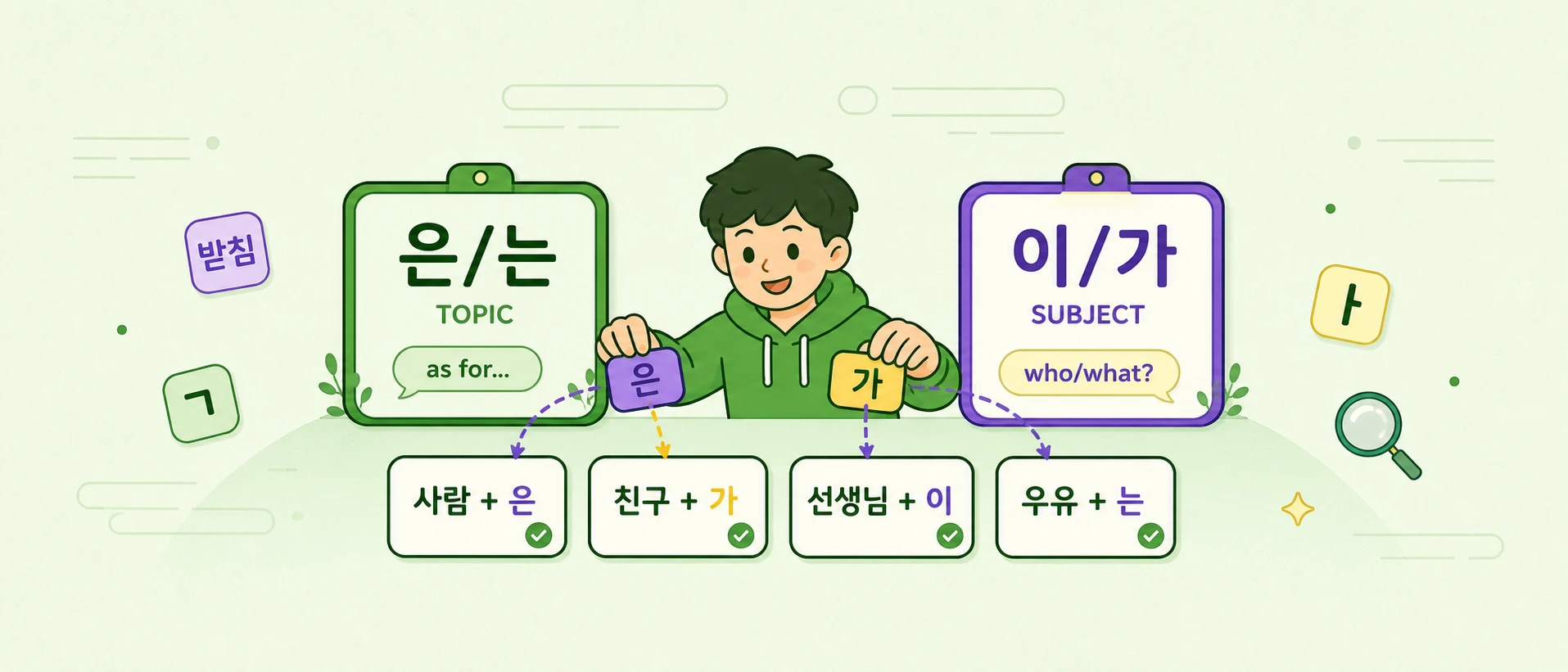
If you've started learning Korean, you've already met the most famous source of beginner confusion: the difference between 은/는 and 이/가. They both seem to mark the subject of a sentence. Textbooks call one the "topic particle" and the other the "subject particle" — and then leave you more confused than before.
Here's the good news: the spelling rule takes thirty seconds to learn, and the meaning difference follows a handful of patterns you can actually internalise. This guide explains 은/는 vs 이/가 simply, with side-by-side examples, so you stop guessing and start choosing on purpose.
What Are Korean Particles?
Korean particles are tiny markers attached to the end of a noun that tell you the noun's job in the sentence. English uses word order for this ("the dog bit the man" vs "the man bit the dog"); Korean uses particles instead, which is why Korean word order is so flexible. (We cover that in full in Korean sentence structure for beginners.)
The three you'll meet first are:
- 은/는 — the topic particle (what the sentence is about)
- 이/가 — the subject particle (who or what is doing the action)
- 을/를 — the object particle (what the action is done to)
This article focuses on the first two — the pair that causes 90% of the confusion.
The Spelling Rule: 은 vs 는, 이 vs 가
Before meaning, master the form. Whether you write 은 or 는 (and 이 or 가) depends on one thing only: the last letter of the noun. If the noun ends in a consonant (a 받침, or "final consonant"), use the version that starts with a vowel; if it ends in a vowel, use the version that starts with a consonant. It's all about smooth pronunciation.
| Noun ends in… | Topic particle | Subject particle | Example |
|---|---|---|---|
| Consonant (받침) | 은 | 이 | 사람 → 사람은 / 사람이 |
| Vowel | 는 | 가 | 친구 → 친구는 / 친구가 |
은/는 — The Topic Particle
Think of 은/는 as putting a noun up on a signboard and saying, "Okay, let's talk about this." It marks the topic — the thing the sentence is about. It does three main jobs:
- Introducing a topic: 저는 학생이에요 — "As for me, I'm a student."
- Making general statements: 커피는 맛있어요 — "Coffee (in general) is delicious."
- Showing contrast: 저는 한국어는 잘하지만 일본어는 못해요 — "I'm good at Korean, but (in contrast) bad at Japanese."
That contrast function is the secret weapon. Whenever you sense an implied "but…" or "as for…", 은/는 is usually right.
이/가 — The Subject Particle
이/가 marks the grammatical subject — the noun that actually performs the action or is being described. It tends to point at something new, specific, or being identified:
- Introducing new information: 친구가 왔어요 — "A friend came" (the friend is new to the conversation).
- Answering "who/what?": 누가 했어요? — 제가 했어요 — "Who did it? — I did."
- Pointing out / identifying: 이게 제 책이에요 — "This is my book."
A useful instinct: if you could put extra stress on the English word ("I did it," "that one"), Korean often wants 이/가.
은/는 vs 이/가: The Real Difference
Rules in a table only get you so far — particles are best understood through contrast. Here's the same idea expressed both ways, so you can feel the shift in emphasis:
제가 했어요.
je-ga haesseoyo
"I did it." — picks you out as the one, often answering "who did this?"
저는 했어요.
jeo-neun haesseoyo
"As for me, I did it." — implies a contrast: maybe others didn't.
날씨가 좋아요.
nalssi-ga joayo
"The weather is nice." — a fresh observation about right now.
날씨는 좋아요.
nalssi-neun joayo
"The weather, at least, is nice." — hints something else isn't (contrast).
Same sentence, different particle, different nuance. The grammar isn't wrong either way — you're choosing what to emphasise. This is exactly why particles are so hard to master from rules alone, and so easy to absorb from lots of listening and real conversation.
Particles finally "click" when someone reacts to how you use them. Practise live in a free trial lesson.
Book a Free Trial Lesson 🗓️When to Use Each: 5 Practical Rules
Until your instinct develops, lean on these defaults:
- First mention → 이/가, after that → 은/는. Introduce something new with 이/가, then keep talking about it with 은/는.
- Answering "who/what?" → 이/가. The new, identifying information takes the subject particle.
- General truths and self-introductions → 은/는. 저는…, 한국은…
- Comparing or contrasting two things → 은/는 on both. "This is X, but that is Y."
- After question words like 누가 (who), 뭐가 (what) → 이/가. These almost always pair with the subject particle.
Common Mistakes Beginners Make
- Using 은/는 for brand-new information. If your friend just walked in, it's 친구가 왔어요, not 친구는 왔어요 (the second sounds like you're contrasting that friend with someone else).
- Picking the particle by meaning before checking the 받침. Decide which particle first, then apply the consonant/vowel spelling rule.
- Translating 은/는 as "the" and 이/가 as "a". It's a helpful hint, not a rule — don't force it.
- Over-thinking in casual speech. Koreans drop these particles constantly when chatting. Learn them properly, then relax.
How 은/는, 이/가 and 을/를 Fit Together
Particles are the engine of Korean grammar. Once 은/는 and 이/가 make sense, the object particle 을/를 follows the same consonant/vowel logic, and you can start building real sentences. The next step is seeing how these markers let Korean put the verb at the end and shuffle everything else around freely — that's the heart of Korean sentence structure. If you're still on the alphabet, start with learning Hangul in one week, and for the bigger roadmap see how to learn Korean online.
Frequently Asked Questions
What is the difference between 은/는 and 이/가?
은/는 is the topic particle — it marks what the sentence is about, makes general statements, and creates contrast. 이/가 is the subject particle — it points out who or what performs the action and usually introduces new or specific information. The same sentence can take either; the choice changes the emphasis, not the core meaning.
When do you use 이 vs 가 (and 은 vs 는)?
It depends only on the last letter of the noun. Use 이 and 은 after a consonant (받침), and 가 and 는 after a vowel. Example: 사람 → 사람이 / 사람은; 친구 → 친구가 / 친구는.
Is 은/는 a subject marker or a topic marker?
It's a topic marker. It often sits where the English subject would be, which is why it gets confused with 이/가, but its real job is to flag the topic or to contrast. The true subject marker is 이/가.
Can you drop particles in Korean?
Yes — in casual spoken Korean, 은/는 and 이/가 are often dropped when context makes the meaning clear. In writing, formal speech, and whenever you want emphasis or contrast, keep them. As a beginner, learn to use them correctly first, then relax them in conversation.
Test what you've learned
5 questions · based on this article
Ready to use 은/는 and 이/가 in real sentences — with a teacher who corrects you?
Book a Free Trial Lesson 🗓️