
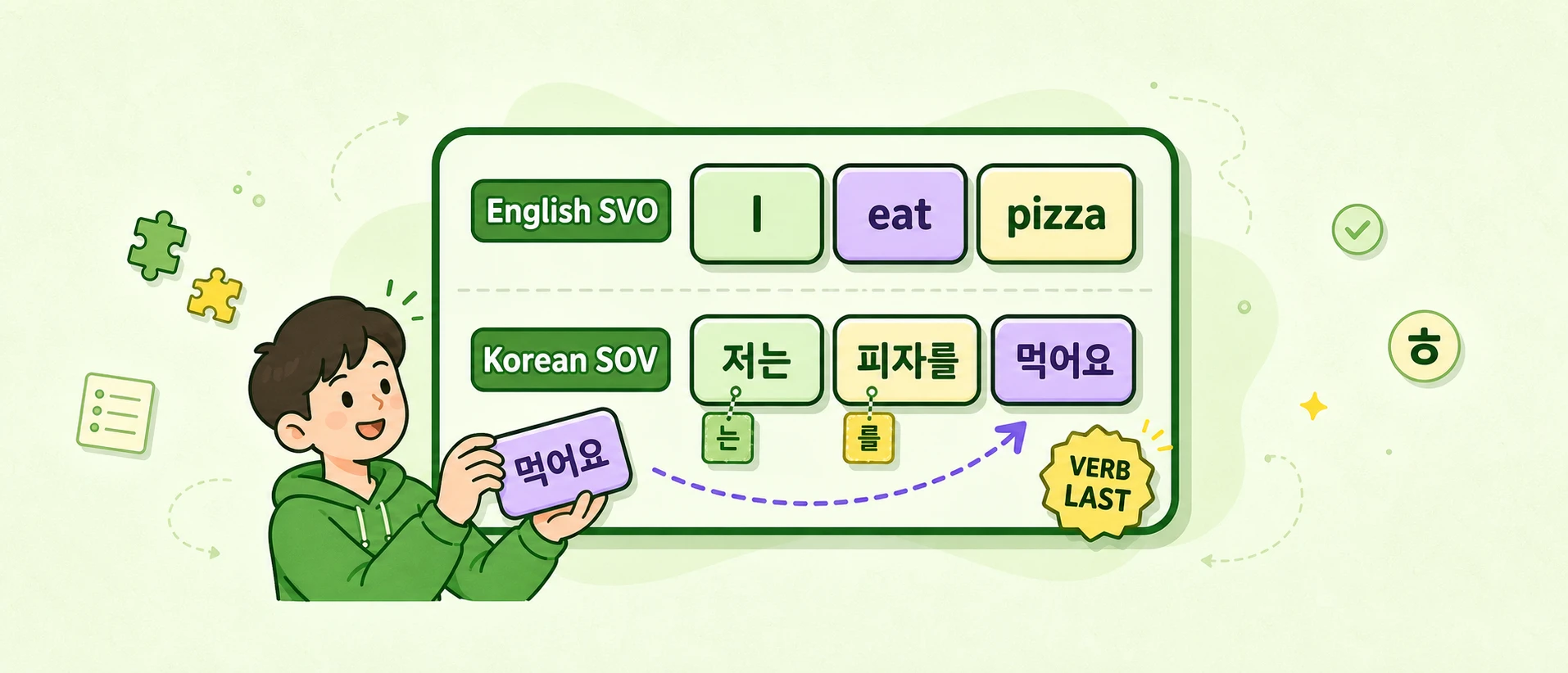
If Korean grammar feels backwards at first, there's a reason — it literally is, from an English speaker's point of view. The single most important thing to understand about Korean sentence structure is this: the verb goes at the end. Where English says "I eat pizza," Korean says the equivalent of "I pizza eat."
Master that one idea and Korean stops feeling random. This guide walks you through the Subject-Object-Verb (SOV) word order, how particles do the work English does with word order, the basic sentence patterns, and exactly how to build your first sentences.
SOV vs SVO: The Core Difference
Languages arrange the three main sentence pieces — Subject, Object, and Verb — in a preferred order. English is SVO. Korean is SOV.
Read the Korean row left to right: "I — pizza — eat." It feels odd for exactly one sentence. After a few weeks of exposure, it becomes invisible — like rearranging furniture you stop noticing.
The Verb Always Comes Last
This is the rule you can build everything on: in a Korean sentence, the verb or adjective is always at the very end. Everything else — subject, object, time, place — comes before it.
"When in doubt, the verb goes last. It is the one position in Korean that almost never moves."
That's why, when you listen to Korean, you often have to wait until the final word to know whether someone is saying they like something, don't like it, or are asking about it. The ending carries the punch.
Particles Do the Work Word Order Does in English
Here's the clever part. In English, position tells you who does what: "the dog bit the man" means something very different from "the man bit the dog." Korean doesn't rely on position — it uses particles, small tags attached to each noun that announce its role:
| Particle | Marks | Example |
|---|---|---|
| 은/는 | Topic | 저는 (as for me) |
| 이/가 | Subject | 친구가 (a friend) |
| 을/를 | Object | 밥을 (rice / a meal) |
Because the particle — not the position — tells you the role, Korean can move the subject and object around and still be perfectly clear. The particles are doing the heavy lifting. They're worth a deep dive of their own: see 은/는 vs 이/가 explained simply.
Word order sinks in when you build real sentences out loud. Try a free trial lesson.
Book a Free Trial Lesson 🗓️The Three Basic Sentence Patterns
Almost every beginner Korean sentence is one of three shapes:
1. Subject – Object – Verb
The full pattern, for actions done to something.
저는 커피를 마셔요.
jeo-neun keopi-reul masyeoyo — "I drink coffee" (lit. "I coffee drink").
2. Subject – Verb
When there's no object, just drop it.
저는 자요.
jeo-neun jayo — "I sleep."
3. Subject – Adjective
Korean adjectives behave like verbs and also go last — no separate word for "is" needed.
날씨가 좋아요.
nalssi-ga joayo — "The weather is nice" (lit. "weather nice").
Building Your First Korean Sentences
Use this simple recipe whenever you want to make a sentence from scratch:
- Pick your subject and add a topic/subject particle → 저는 (I).
- Add the object (if any) with 을/를 → 한국어를 (Korean).
- Put the verb last → 공부해요 (study).
Result: 저는 한국어를 공부해요 — "I study Korean." Swap the nouns and verb and you can generate dozens of sentences from this one frame. (To pick verb endings correctly, you'll also want Korean particles (은/는 vs 이/가) down first.)
Want to hear this recipe in action? This podcast episode builds basic Korean sentences step by step at a slow, beginner-friendly pace, so you can hear how the subject–object–verb order actually sounds when spoken. Listen and you'll start to feel the verb-last rhythm rather than just memorising it:
▶ Ep 9: hearing basic Korean sentences built step by step
A fresh beginner episode lands every week. Subscribe to SoodaKorean on YouTube 🔔 to keep hearing real Korean sentences between study sessions.
Korean Word Order Is Flexible (But the Verb Stays Last)
Because particles mark roles, you can shuffle the subject and object for emphasis, and Korean speakers do this all the time. 저는 커피를 마셔요 and 커피를 저는 마셔요 are both understandable — the second just front-loads "coffee" for emphasis. The verb, though, stays put at the end.
Dropping the subject
Korean also loves to drop whatever's obvious from context. If it's clear you're talking about yourself, you can skip 저는 entirely and just say 커피를 마셔요 — "(I) drink coffee." This is normal, natural Korean, not lazy Korean.
Where to Go Next
You now have the skeleton of Korean grammar. The natural next steps: nail the 는/은 vs 이/가 particles that make this word order work, make sure your Hangul reading is solid, and follow the full beginner roadmap in how to learn Korean online. Then the real growth comes from building sentences out loud until verb-final word order feels automatic.
Frequently Asked Questions
What is the basic Korean sentence structure?
Subject-Object-Verb (SOV). Where English says "I eat pizza," Korean says the equivalent of "I pizza eat" — the verb always comes at the end. The two other core patterns are Subject-Verb ("I sleep") and Subject-Adjective ("the weather is nice").
Is Korean SOV or SVO?
Korean is SOV; English is SVO. The defining feature of Korean word order is that the verb or adjective comes last, no matter what else is in the sentence.
Why does the verb come last in Korean?
Korean is a verb-final language, and it works because particles attached to each noun show its role. Since the particles — not the position — tell you who does what, the verb can sit at the end and still be clear.
Is Korean word order flexible?
Partly. Because particles mark each noun's role, you can move the subject and object for emphasis, and drop them when context is clear. The firm rule is that the verb stays at the end.
Test what you've learned
5 questions · based on this article
Ready to turn "I pizza eat" into real, flowing Korean sentences?
Book a Free Trial Lesson 🗓️