
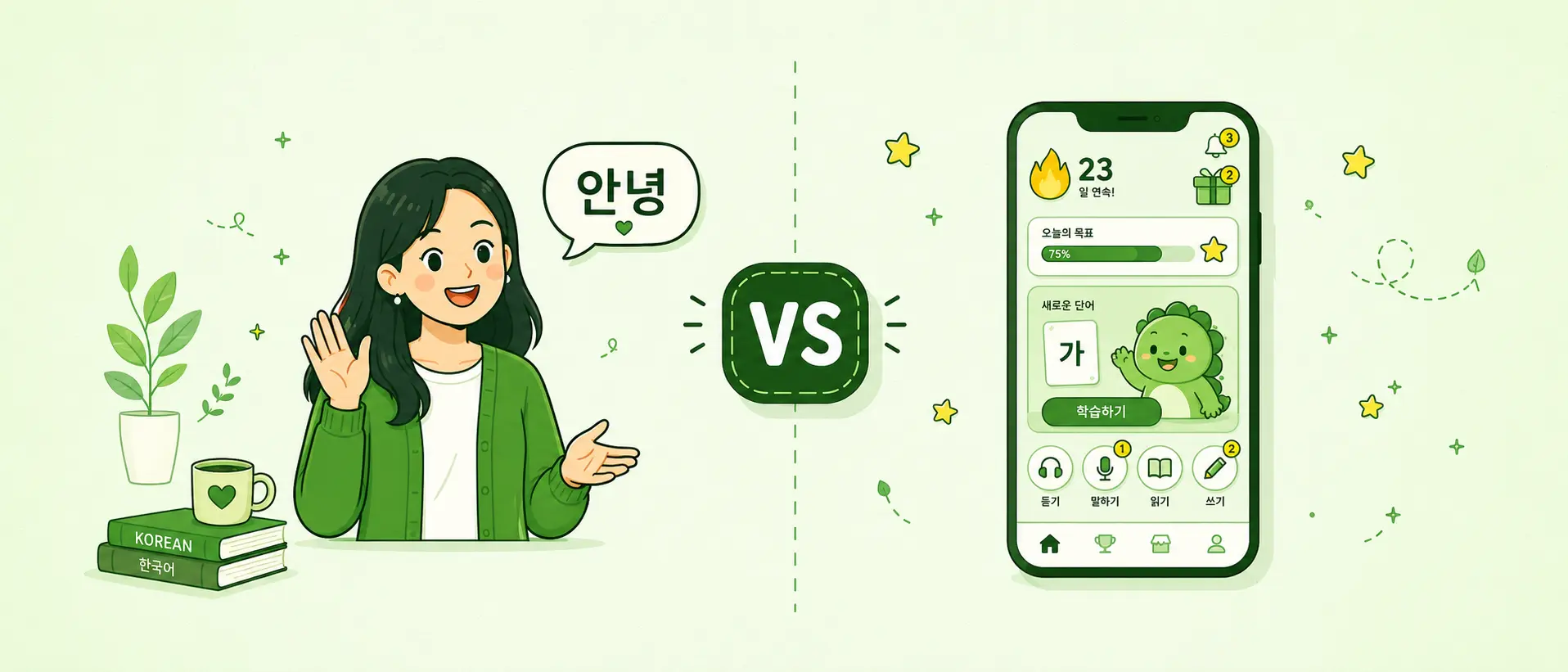
You've got a 200-day streak. You've "completed" the Korean tree. You can tap the right answer almost without thinking. And yet — a real Korean person says 안녕하세요 to you, and your mind goes completely blank.
If that's you, you're not lazy and you're not bad at languages. You've just hit the ceiling that every app-only learner eventually hits. This article breaks down honestly what apps like Duolingo, Babbel, and Memrise do well, where they quietly hold you back, and what a tutor adds that no app ever will. No app-bashing — just the truth about what it actually takes to speak Korean.
Why Apps Feel So Productive (But Often Aren't)
Language apps are brilliantly designed — to keep you opening the app. Streaks, points, little celebrations: they're built around engagement, not fluency. That's not evil, but it's worth understanding, because the feeling of progress and actual progress are two different things.
Tapping the correct translation from four options is recognition. Speaking Korean requires production — pulling the word out of your own head, pronouncing it correctly, and arranging it into a sentence in real time while someone waits for your answer. Recognition is a fraction of the difficulty of production, so an app can make you feel advanced while your speaking ability is still at zero.
What Apps Actually Do Well
Let's be fair — apps earn their place in your routine. Here's where they genuinely shine:
- Building a daily habit — five minutes a day adds up, and the reminders work
- Vocabulary exposure — drilling common words into recognition memory
- Low pressure — no one's watching when you get it wrong, which lowers the barrier to starting
- Free or cheap — a no-risk way to test whether you actually enjoy Korean
- Always available — a bus, a queue, a lunch break — micro-practice anywhere
If you're using an app to keep Korean warm between lessons, you're using it exactly right. The problem only starts when the app is your whole plan.
Where Apps Fall Short (The 4 Gaps)
Every one of these gaps is something a human teacher fills automatically — and none of them can be coded into a tap-the-answer interface.
1. They don't make you speak
Even apps with "speaking" exercises just check whether your voice roughly matches a waveform. They never ask you an unexpected question, never react to what you want to say, and never push you to build a sentence from scratch. Speaking is a skill built only by speaking — to a person who responds.
2. They can't correct your real mistakes
Apps mark you right or wrong. They can't tell you why your 받침 pronunciation sounds off, or that the particle you chose is grammatically fine but sounds unnatural to a native ear. Uncorrected mistakes harden into habits — and bad pronunciation habits are painfully hard to undo later.
3. They teach everyone the exact same thing
An app can't know that you're learning Korean to talk to your partner's family, or to travel through Busan, or to understand your favourite variety show. It serves the same fixed tree to a teenager in Brazil and a retiree in Canada. A tutor builds the lesson around your goal, so every minute is relevant.
4. There's no real accountability
Missing an app's notification costs you nothing but a cartoon owl's disappointment. A booked lesson with a real person who remembers your progress is a commitment you actually keep — and that consistency is what produces results.
What a Tutor Adds That No App Can
A good Korean teacher isn't just "an app with a face." They do things that are structurally impossible for software:
- Real-time correction — fixing pronunciation and grammar the moment it happens, before it becomes a habit
- Unscripted conversation — the messy, reactive practice that actually builds fluency
- Context and culture — when to use formal vs. casual speech, what sounds natural vs. textbook
- A plan built around you — your goals, your weak spots, your pace
- Encouragement and accountability — someone who notices your progress and keeps you going on the hard weeks
Here's the kind of unscripted, real-life conversation that apps can't replicate — and that a tutor builds with you live. In this podcast episode you'll hear a natural Korean conversation about asking for and giving directions, at a beginner-friendly pace. Notice how the back-and-forth flows in ways no multiple-choice drill ever could:
▶ Ep 55: a real Korean conversation — asking for directions
Listening to natural conversation is great practice between lessons. Subscribe to SoodaKorean on YouTube 🔔 for a new conversation episode every week.
Curious what a real lesson feels like after months of tapping? The first one's free — no credit card, no pressure.
Book a Free Trial Lesson 🗓️"But Apps Are Free" — The Hidden Cost
Apps look free, and a tutor looks expensive. But the real currency in language learning isn't money — it's time. Spending two years tapping your way to a permanent beginner plateau is far more expensive than a few months of focused lessons that actually get you speaking.
Think of it this way: the app is the gym membership; the tutor is the coach who makes sure you're not doing the exercises wrong for a year. You can absolutely combine them — and the best learners do.
Korean Tutor vs. App: Side by Side
| What matters | Apps (Duolingo, etc.) | A tutor |
|---|---|---|
| Speaking practice | Minimal / scripted | Core of every lesson |
| Mistake correction | Right / wrong only | Personalised, in context |
| Pronunciation | Waveform matching | Native ear, real feedback |
| Personalisation | Same path for everyone | Built around your goals |
| Accountability | App notifications | A real, scheduled commitment |
| Cost | Free / low | Higher per hour, faster results |
| Best for | Daily review & vocab | Actually learning to speak |
The Best Setup: Use Both
This was never really tutor or app. The fastest, most affordable path combines them:
- Daily (10–15 min): an app or SRS flashcards to keep vocabulary fresh
- 1–2× per week: a live lesson for speaking, corrections, and a plan
- For fun: Korean content — music, dramas, variety shows — for immersion and motivation
The app keeps your foundation warm. The tutor turns that warm foundation into real conversation. Together they're far more powerful than either alone. If you want a full weekly structure, see our 30-day Korean study plan for beginners, and when you're ready to talk, here's how to practise speaking Korean even if you have no one to talk to yet.
Frequently Asked Questions
Can you become fluent in Korean with Duolingo?
No app alone will make you fluent. Duolingo and similar apps are excellent for building vocabulary, a daily habit, and basic recognition — but fluency requires producing the language out loud, getting your mistakes corrected, and adapting to real conversation. Those are things only speaking practice with a person provides.
Is a Korean tutor worth it compared to a free app?
If your goal is to actually speak Korean, yes. Apps are free but slow — most app-only learners plateau at beginner level. A tutor corrects pronunciation before bad habits set in, explains grammar in context, and forces you to speak, which is the single biggest accelerator. Many learners use both: apps for daily review, a tutor for real practice.
Should I use an app and a tutor at the same time?
That's the most effective setup. Use an app for daily vocabulary and grammar drills between lessons, and a tutor once or twice a week for speaking, corrections, and accountability. The app keeps your foundation warm; the tutor turns that knowledge into actual conversation ability.
Tutor or app? Test yourself
5 questions · based on this article
Done tapping? Turn what you know into real conversation with a free trial lesson.
Book a Free Trial Lesson 🗓️