
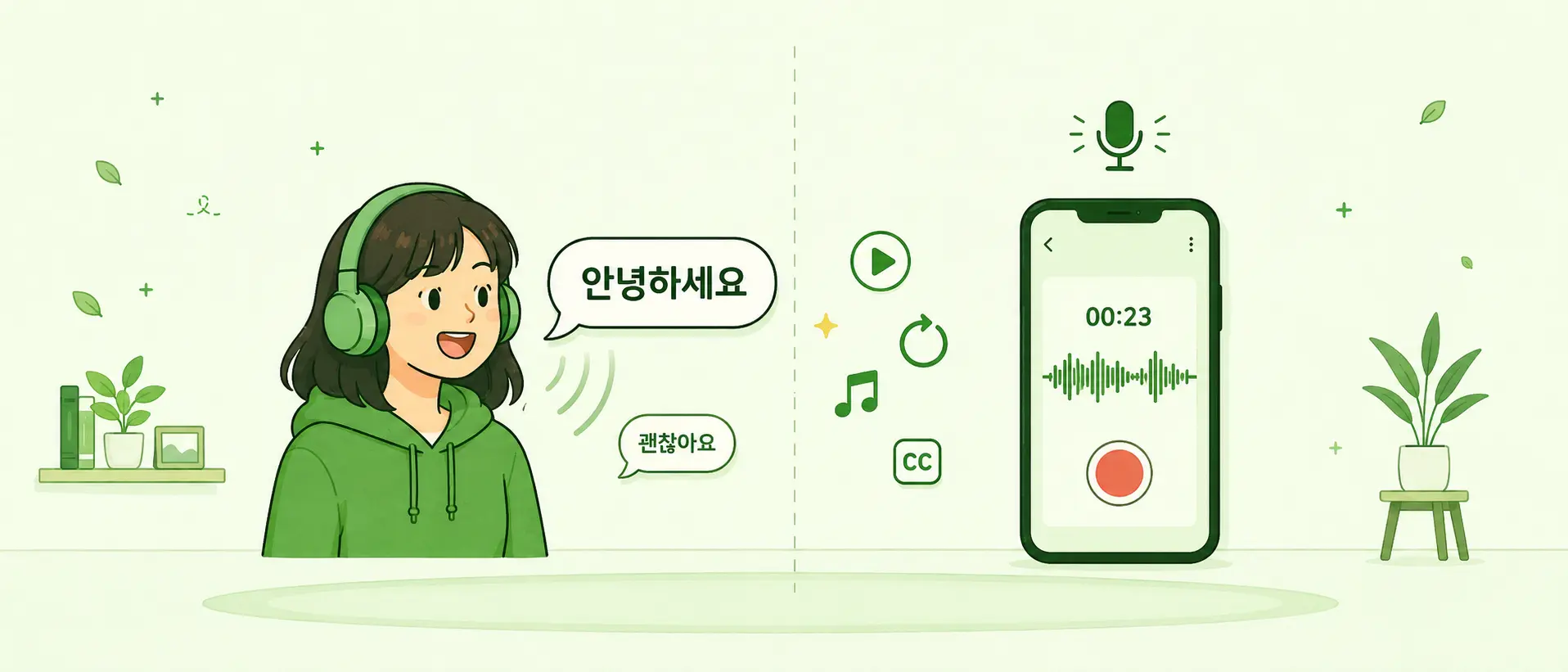
Here's the cruel irony of learning Korean: speaking is the one skill you actually want — and it's the hardest to practise alone. You can read, listen, and drill flashcards by yourself all day. But speaking? That seems to need another person.
It doesn't. Not at the start, anyway. The speaking "muscle" — pulling words from memory, shaping the sounds, building sentences in real time — can be trained solo, and you can get surprisingly far before you ever sit across from a conversation partner. Here are seven ways to practise speaking Korean by yourself, plus the one method that multiplies all of them.
Why Speaking Feels So Much Harder
Reading and listening are input skills — your brain just has to recognise what's already there. Speaking is an output skill: you have to produce the language from scratch, fast, while also managing pronunciation and grammar. That's three jobs at once, which is why even learners with big vocabularies freeze when it's time to talk.
The fix is simple but uncomfortable: you have to actually make noise. Silent study never trains output. Every method below has one thing in common — your mouth is moving.
1. Narrate Your Day to Yourself
Describe what you're doing, out loud, in Korean — as you do it. 커피를 마셔요 ("I'm drinking coffee"). 지금 나가요 ("I'm going out now"). It feels silly, and that's fine. Self-talk turns dead time into speaking reps and quickly shows you exactly which everyday words you're missing.
2. Shadowing — Repeat After Native Audio
Shadowing is listening to a native speaker and repeating what they say almost simultaneously, copying their rhythm and intonation. Use a podcast, a YouTube clip, a drama line, or a chorus from our K-pop lyrics method. Replay one sentence, say it out loud matching the speaker, repeat until it flows. This trains your ear and mouth together and is the fastest route to sounding natural rather than robotic.
Here's a ready-made shadowing track. This podcast episode drills -고 싶어요 ("I want to…") sentences slowly and repeatedly, with clear native pronunciation and natural pauses — pause after each line, repeat it out loud, and copy the rhythm:
▶ Ep 35: "I want to…" sentence practice — built for repeating out loud
We release a new practice episode every week. Subscribe to SoodaKorean on YouTube 🔔 for a steady supply of native audio to shadow.
3. Read Korean Out Loud
Whatever you're studying — a textbook dialogue, song lyrics, a news headline — read it aloud instead of in your head. This builds the physical fluency of moving your mouth through Korean sounds and reinforces 받침 (final consonants) and linking, which are where most beginners stumble. If you're still shaky on reading, start with our guide to learning Hangul in one week.
4. Record Yourself and Listen Back
Open your phone's voice recorder and answer a simple question — "What did you do today?" — in Korean for 30 seconds. Then listen back. It's cringey, but it's gold: you'll hear hesitations, mispronunciations, and gaps you can't notice while speaking. Re-record until it's smoother. Save the clips and compare month to month — the progress is hugely motivating.
5. Think in Korean
Throughout the day, try to label your thoughts in Korean instead of your native language. See a dog? 강아지. Hungry? 배고파요. This builds the instant word-recall that real conversation demands, and it costs you zero extra time.
6. Use AI and Language-Exchange Apps
When you want a "partner" without the pressure, voice-based AI tutors and language-exchange apps let you rehearse low-stakes exchanges. They're imperfect — they won't reliably catch subtle errors or teach you what sounds natural — but they're a useful bridge between talking to yourself and talking to a real teacher.
7. Lessons With a Tutor — The Multiplier
Every solo method above builds the muscle. But a real teacher is what turns reps into fluency. A tutor reacts to what you actually say, corrects pronunciation before it sets, asks the unexpected follow-up question that real conversation is made of, and gently pushes you past your comfort zone. One weekly lesson on top of daily self-practice produces dramatically faster results than either alone — it's the difference between practising free-throws and playing the game.
Not sure whether to rely on apps or a teacher? We compared them in Korean tutor vs. apps. And if you're building your routine from scratch, our complete guide to learning Korean online ties all of this together.
You've practised alone — now try it for real. Your first conversation lesson is free.
Book a Free Trial Lesson 🗓️3 Mistakes That Keep You Silent
- Waiting to feel ready — readiness comes from speaking, never before it
- Studying silently — if your mouth isn't moving, you're not practising speaking
- Fearing mistakes — every error you make out loud and correct is a rep; errors are the path, not the obstacle
"Fluency isn't the absence of mistakes — it's the willingness to keep talking through them."
Frequently Asked Questions
How can I practise speaking Korean if I have no one to talk to?
Use solo methods: narrate your day out loud, shadow native audio, read Korean aloud, record yourself and listen back, and think in Korean during the day. These build the speaking muscle even before you have a partner — though regular lessons with a tutor accelerate everything.
What is shadowing?
Shadowing means listening to native Korean audio and repeating it out loud almost simultaneously, copying pronunciation, rhythm, and intonation as closely as you can. It trains your mouth and ear together and is one of the most effective solo techniques for sounding natural.
How long until I can hold a conversation?
With daily speaking practice and regular lessons, many learners manage simple everyday conversations within 3 to 6 months. The biggest factor is how early and how often you speak out loud — those who start imperfectly from week one progress far faster than those who wait. For a full breakdown, see how long it takes to learn Korean.
Test what you've learned
5 questions · based on this article
Ready to speak Korean with someone who'll help you get it right?
Book a Free Trial Lesson 🗓️