
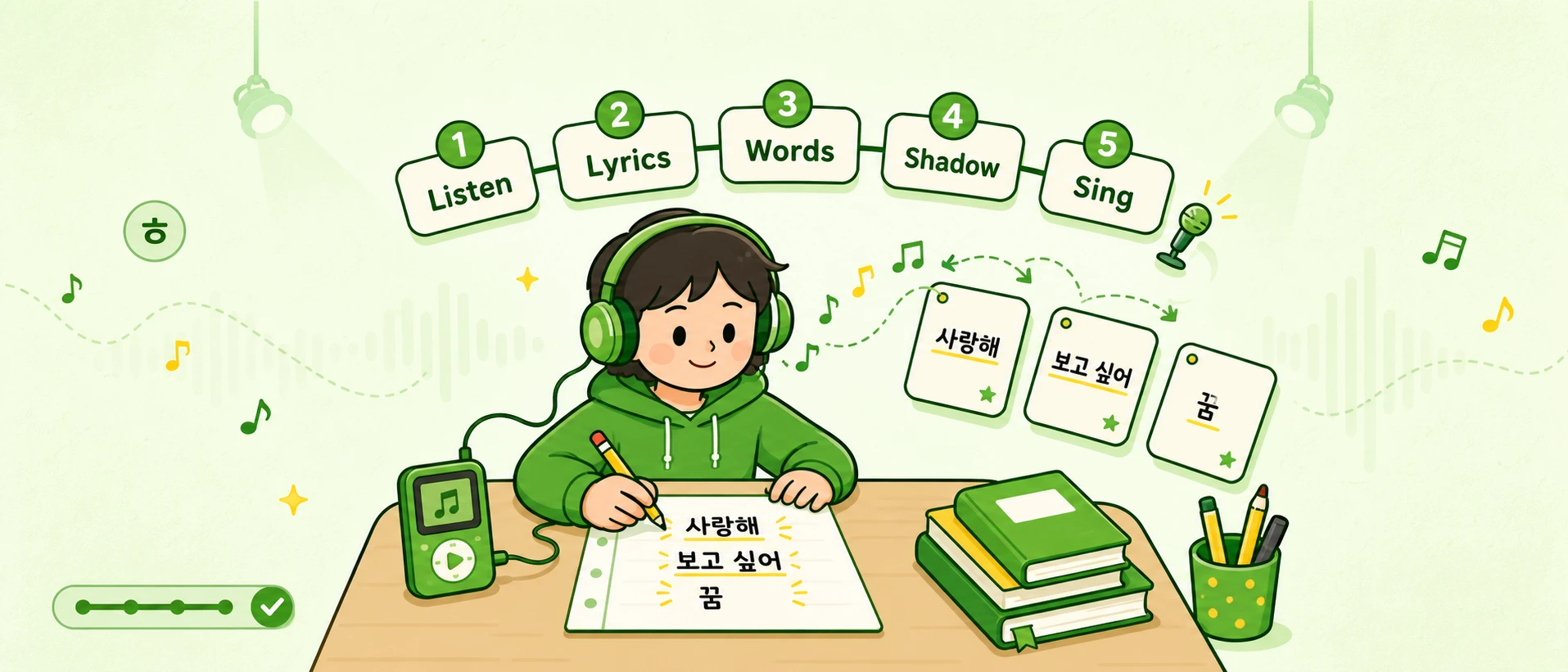
You already have a Korean playlist on repeat. The chorus is stuck in your head, you half-know the words, and you're wondering: could I actually learn Korean with K-pop?
The honest answer is yes — if you do it on purpose. Passively streaming songs won't teach you much. But turn that same music into structured input with the simple lyrics method below, and your favourite tracks become some of the most motivating vocabulary and listening practice you'll ever get. Let's break down exactly how — and where K-pop's limits are.
Why K-Pop Works for Learning Korean
Music is a memory hack. There's a reason you can recall song lyrics from years ago but forget a phone number in seconds — melody and repetition burn words into long-term memory. K-pop leans into this:
- Repetitive choruses drill the same phrases until they're automatic.
- Catchy melodies make vocabulary stick without rote memorisation.
- Emotional connection — you want to understand a song you love, and motivation is the #1 predictor of language success.
- Native pronunciation and rhythm train your ear to real Korean sounds.
In other words, K-pop is fantastic input — listening and vocabulary — wrapped in entertainment you'd consume anyway.
What K-Pop Can (and Can't) Teach You
Here's the part most "learn Korean with K-pop" articles skip. Lyrics are poetry, not textbooks. To fit rhythm and rhyme, songwriters drop particles, flip word order, and reach for slang and abbreviations (our guide to Korean slang you'll actually hear decodes most of them). So be clear about what you're getting:
| K-pop is great for… | K-pop is weak for… |
|---|---|
| Vocabulary & common phrases | Correct, everyday grammar |
| Listening & pronunciation | Formal / polite speech levels |
| Reading Hangul fast | Producing your own sentences |
| Motivation & immersion | Speaking & conversation |
The 5-Step Lyrics Method
Pick one song you love — ideally something mid-tempo with a clear, repetitive chorus — and run it through these five steps. One song done properly beats ten songs half-listened to.
-
1Listen on repeat (no lyrics yet) Play it 5–10 times just to get the sounds in your ear. Don't worry about meaning — you're training recognition.
-
2Read the lyrics in Hangul + translation Pull up the Korean lyrics next to an English translation. Read along while listening so your eyes connect the sounds to the script.
-
3Mine 5–10 words from the chorus Don't try to learn the whole song. Pick the most useful repeated words, add them to a flashcard app, and review them daily.
-
4Shadow the chorus Play one line, pause, and repeat it out loud — copying the rhythm and pronunciation exactly. This "shadowing" is where your accent improves.
-
5Sing it from memory Once you can sing the chorus without the lyrics, those words are yours. Move to the next verse, or the next song.
Korean Words You Already Know from K-Pop
If you've listened to much K-pop, you already know more Korean than you think. These show up constantly:
| Korean | Romanisation | Meaning |
|---|---|---|
| 사랑해 | saranghae | I love you |
| 보고 싶어 | bogo sipeo | I miss you |
| 가지 마 | gaji ma | Don't go |
| 너 | neo | you |
| 마음 | maeum | heart / mind |
| 꿈 | kkum | dream |
| 행복 | haengbok | happiness |
| 대박 | daebak | awesome / jackpot |
Recognise a few of those? That's the K-pop advantage — you're starting with a vocabulary head start most beginners don't have.
You can sing 사랑해 — but can you hold a conversation? That's the gap a teacher closes fastest.
Book a Free Trial Lesson 🗓️Easy K-Pop Songs for Beginners
You don't need a specific artist — you need the right kind of song. For your first lyrics-method song, look for:
- Slower tempo — ballads and mid-tempo tracks over fast rap.
- Clear pronunciation — singers who enunciate, not mumble.
- Repetitive, simple choruses — short phrases you can grab quickly.
- Everyday emotional vocabulary — love, missing someone, dreams — high-frequency words you'll actually reuse.
A good rule of thumb: if you can already hum the chorus and it has lots of repeated words, it's a great candidate. Save the rapid-fire rap verses for when you're more advanced.
A great example is 아리랑 (Arirang) — Korea's most beloved folk song, and the melody behind BTS's latest release, so it bridges traditional and K-pop Korean beautifully. In this podcast episode we talk about the song and the story behind it — a gentle, beginner-friendly listen that shows how music opens a door into Korean:
▶ Ep 65: the story of Arirang — the folk song behind BTS's new track
We turn songs and everyday Korean into beginner listening practice every week. Subscribe to SoodaKorean on YouTube 🔔 to learn Korean through the music you love.
Drop the Romanisation
It's tempting to read lyrics in "saranghae" style romanisation forever. Don't. Romanisation is inconsistent, trains a slightly-wrong accent, and caps how much you can grow. The fix is small: learn to read Hangul first — most motivated learners manage it in under a week — and then read lyrics directly in Korean. Suddenly every lyric video, subtitle, and caption becomes practice. Start here: How to Learn Hangul in One Week.
From Singing to Speaking
K-pop gets you a great ear, a pile of vocabulary, and real motivation. What it can't do is talk back — correct your pronunciation, untangle your grammar, or push you to build your own sentences. That's the wall almost every self-studier hits, and it's exactly where a teacher earns their keep.
The ideal combo: keep K-pop as your daily fun input, add structured grammar (start with Korean sentence structure and Korean particles 은/는 vs 이/가), and get speaking practice with someone who reacts to you. If you want the full roadmap, see how to learn Korean online and our guide to practising speaking Korean. And yes — bringing a lyric you love to a lesson and asking "what does this actually mean?" is one of the best ways to learn.
Frequently Asked Questions
Can you actually learn Korean from K-pop?
Yes, with limits. K-pop is excellent for vocabulary, pronunciation, listening, and motivation because catchy, repetitive lyrics stick. It's weak for grammar and speaking, since lyrics use slang and poetic word order. Use it as fun, high-volume input alongside structured grammar study and real speaking practice.
What are some easy K-pop songs to learn Korean?
Choose slower songs with clear pronunciation and repetitive choruses. Ballads and mid-tempo tracks beat fast rap. Start with a chorus built on simple everyday phrases like 보고 싶어 (I miss you) or 사랑해 (I love you), learn one line first, then expand. And once 사랑해 is permanently stuck in your head, learn all its forms and when to use each in our guide to saying I love you in Korean.
Should I use romanisation for K-pop lyrics?
Only briefly, at the very start. Romanisation trains inaccurate pronunciation and slows you down. Learn Hangul first — it takes only a few days — then read lyrics directly in Korean.
Is the Korean in K-pop grammatically correct?
Not always. Songwriters bend grammar for rhythm and rhyme, drop particles, and use slang. That's fine for vocabulary and listening, but it's why you shouldn't learn grammar from lyrics alone. Pair K-pop with a structured grammar source or a teacher.
Test what you've learned
5 questions · based on this article
Bring your favourite lyric to a free trial lesson — and finally understand every word.
Book a Free Trial Lesson 🗓️